 ..
..
Arthropods (Insects, Spiders, etc.)
This page will always be under construction! For a listing of our sources for all our pages on the Arthropods, for various valuable links to other websites, and for comments on the status of these pages, see the paragraph at the bottom of this page.
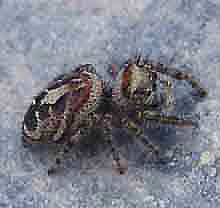 The phylum Arthropoda -- all those bilaterally symmetrical animals who possess external skeletons composed of chitin (a cellulose -- linear-chain hydrocarbon that forms a strong yet somewhat flexible shell), with segmented bodies and paired, jointed legs (insects, spiders, scorpions, crustaceans, centipedes, etc.) -- is far more diverse than are members of the chordate phylum to which all vertebrates including humans belong. Indeed, the number of Arthropod species is far greater than those of all other phyla combined, and there are probably millions of species among the insects alone which have not yet even been identified and described. For a visual image of this varietal dominance, see this link: Group Diversity.
The first creatures to leave the sea had shells made of chitin and had jointed legs (think of horseshoe crab-like creatures, the Euryptids or "sea-scorpions, who predate the earliest fishes), so they could move around on land and even breathe if their gill-plates stayed moist, though their size on land was limited by this kind of skeletal structure.
Moreover, the importance of the Arthropods to our ecosystems is huge, despite their individually small sizes, and they may well be considered the most successful animals on the planet -- ancient and contemporary inhabitants of sea, land, and air. The Trilobites of the Cambrian Period (540 MYA) and later Paleozoic are perhaps the best-known ancestral form.
In our discussions of a very few examples of these creatures which follow in the pages linked below, we will try (over time) to build an understanding of them in light of their significance for our ecosystems.
The classification we use here follows McGavin (cited below). The phylum Arthropoda may be divided into two major subphyla:
1) Mandibulates -- those possessing antennae, and highly modified jaws for biting or chewing; these include
a) Myriapods -- having 9 or more pairs of legs and two antennae, for example the Centipedes and Millipedes;
b) Hexapods -- 6-legged arthropods having two antennae, including above all the class Insecta (the only winged arthropods) and also some related orders (Springtails and Bristletails); and
c) Crustaceans -- mainly aquatic, having 4 antennae -- but including not only such ancient sea forms as barnacles, crabs, and shrimp but also such terrestrial isopods as the pillbug (found in our area);
and the
2) Chelicerates -- with no antennae; they have"chelicerae" -- paired, jointed jaws that house fangs or pincer-like mouthparts -- and four pairs of legs. These are prominently the Arachnids -- Spiders, Scorpions, Pseudoscorpions, mites & ticks-- as well as Horseshoe Crabs, Daddy Long-legs, and some extinct sea-scorpions.
Below, click on the blue underlined headings to enter the relevant pages.
1) Mandibulates
1a) Myriapoda
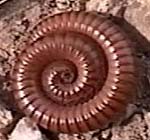
While some 800 species are known of other orders of Mandibulates who have 9 or more pairs of legs and two antennae, the Centipedes and Millipedes have some 13,000 species between them. The former are mostly nocturnal predators who use poisoned claws to kill prey, the latter eat mainly rotting organic matter or fungi.
Centipedes
Millipedes
.................................................
1b) Hexapoda (Insects et al.):
Among the Hexapods, the insects are unique: one line of them invented flight -- indeed, were the first creatures in the history of life to do so, which gave them tremendous evolutionary advantage. Insects are also the only terrestrial animals besides vertebrates to develop hearing, though not all varieties of insect have done so. Locations of tympanal ears may be found all over various insect bodies -- on legs, wings, abdomen, etc.
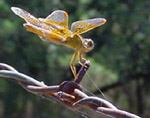 Odonata:
These insects have "two pairs of long membranous wings nearly equal in size and with many cross veins" (Castner p. 55). Their heads have biting mouthparts, short antennae, and very large sphericoid compound eyes. The aquatic nymphs are predaceous.
Dragonflies and Damselflies
..........................................
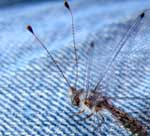 Neuroptera:
The two large, membranous wings of these insects are usually held "roof-like over the body" (Castner p. 107), and they have long and variable antennae (see the image here).
Lacewings, Antlions, Owlflies, et al
.................................................
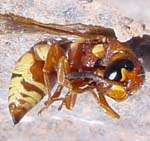 Hymenoptera:
Most members have two pairs of membranous wings, joined in flight by tiny hooks. While the most primitive members of the group (sawflies and their kin) have ovipositors (egg-depositing organs, shaped like saws -- hence the name "sawfly"). In the most evolved members -- the wasps, ants, and bees -- these ovipositors have evolved into stingers (aculeate = "having a stinger/barb").
The root ancestral stock of the Hymenoptera appear to have been close to the primitive sawflies or leaf wasps and wood wasps -- who lack the "wasp waist" and feed entirely on plant materials. Fossils of these most primitive Hymenoptera appear in the Triassic Period of nearly 200 million years ago, looking like a contemporary form of leaf wasps, who feed on pine cone stamina.
All of the more advanced Hymenoptera, in contrast, feed (at least at some stage of the life cycle) on animal food. These more advanced Hymenoptera form the Suborder Apocrita -- characterized by the narrow waist joining two segments of the abdomen, the so-called "wasp waist", which has the adaptive advantage of moving the posterior body in several directions (for stinging or egg-laying). Among the Apocrita, the aculeate -- stinging -- Apocrita include the wasps, ants, and bees:
Wasps
Ants
Bees
.................................................
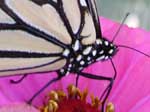 Lepidoptera:
These insects have tiny, overlapping scales on the body and wings, and multisegmented antennae. Usually the mouthparts form a liquid-ingesting proboscis. While moths and butterflies show no scientific differences, moths are usually nocturnal, butterflies diurnal in their activities.
Butterflies
Moths
.................................................
 Diptera:
Dipterans have only one functional pair of wings [the second set of wings has been reduced to small, club-shaped balancing organs called "halteres"], large eyes, and (typically) sucking mouthparts. These are the "True Flies". They are more closely related to the Lepidoptera than they are to the Hymenoptera or Coleoptera
Flies
.................................................
 Coleoptera:
Coleoptera (meaning "sheath wings") -- the Beetles -- are the most diverse of all insects, but their distinguishing feature is 2 toughened forewings (elytra) that protect the 2 larger, membranous hindwings folded beneath. These toughened forewings typically meet down a straight midline of the body. The combination of protective forewings and tough, strong bodies enable them to survive in a huge variety of habitats, and they take extremely diverse forms.
Beetles
..........................................
 Hemiptera:
There are some 134 families and 82,000 species of "Bugs", found all over the world and in great variety. All have piercing, sucking beaks protruding from the front of the head; most have a triangular structure on the back between the bases of the wings (the scutellum), and most have two pairs of wings, with the forewing basally thickened and leathery.
Bugs
.................................................
 Orthoptera:
Grasshoppers, locusts, crickets, katydids and their kin are distinguished primarily by their long hind legs modified for jumping, and they have mouth parts modified for chewing various kinds of plants. Most have toughened leathery forewings that protect the larger hindwings. "Singing" (making noises by rubbing together specialized organs on either legs or wings -- signals used in courtship etc.) is common, and metamorphosis is incomplete.
Grasshoppers (Suborder Caelifera)
Katydids & Crickets (Suborder Ensifera)
..........................................
 Mantodea:
Have front legs distinctively modified for catching prey; elongated prothorax, toughened forewings and large, membranous hindwings.
Mantids
..........................................
 Isoptera:
Two pairs of equal-length wings, when present; bead-like antennae; 3 physically distinct castes; live in dark nests and tunnels, eat cellulose-rich vegetable matter.
Termites
..........................................
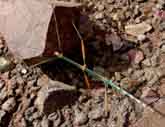 Phasmatodea:
Stick- or leaf-shaped body; widely separated, similar legs, modified for walking.
Walking Sticks
..........................................
Note: the above by no means exhaust the relevant orders of insects. More will be added as time and local experience permit.
..........................................
2) Chelicerates
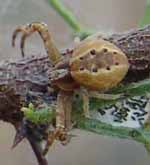
Lacking antennae, and possessing "chelicerae" -- paired, jointed jaws that house fangs or fang-like mouthparts, and four pairs of legs, these Arthropods are most strongly represented by the
 Arachnids,

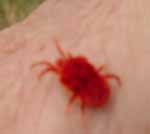
whose most ancient order are the Scorpions, but which besides Spiders includes a variety of pseudo-scorpions and pseudo-spiders as well as ticks and mites (note the Red Mite in the image above right, walking on a small portion of a human wrist).
Scorpions
Windscorpions
Spiders
Harvestmen
Ticks & Mites
..........................................
Source: We are at the very beginning of our descriptions for this realm. For a phenomenally informative and beautifully illustrated reference and identification source, visit BugGuide. For systematic treatment, see the The Tree of Life website of the University of Arizona, and the UC Berkeley Taxon Lift. Another valuable source for the insects of our area is the Sonoran Arthropod Studies Institute (SASI). For texts that consider Arthropods of the Sonoran Desert, an excellent general guide may be found in Phillips, Steven & Patricia Comus, eds., 2000, A Natural History of the Sonoran Desert, Arizona-Sonora Desert Museum Press. For excellent references on insect biology, see Chapman, R.F., The Insects: Structure and Function, 4th ed., Cambridge Univ. Press, 1998, Milne, Lorus and Margery Milne, 1980, The Audubon Society Field Guide to North American Insects and Spiders, Alfred A. Knopf, NY, and McGavin, George, 2002, Insects: Spiders and other Terrestrial Athropods, DK Smithsonian Handbooks. A new volume, Encyclopedia of Insects, 2003, Resh, Vincent & Ring Carde, eds., NY: Academic Press, is very comprehensive, and an excellent guide to insect identification is Castner, James, 2004, Photographic Atlas of Entomology and Guide to Insect Identification, Gainesville, FL: Feline Press. Eisner, Thomas, 2003, For Love of Insects, provides illuminating accounts of recent research on a variety of insect types. Further sources will be given in the pages dealing with specific kinds of Arthropods.
Back to Our Lands and Their Creatures