..
..
Mantises (Order Mantodea)
Milne, Lorus and Margery Milne, 1980, The Audubon Society Field Guide to North American Insects and Spiders, Alfred A. Knopf, NY, and McGavin, George, 2002, Insects: Spiders and other Terrestrial Athropods, DK Smithsonian Handbooks; Hurd, Lawrence, 2003, "Mantodea", in Resh, Vincent & Ring Carde, eds., 2003, Encyclopedia of Insects, NY: Academic Press, pp. 675-7.
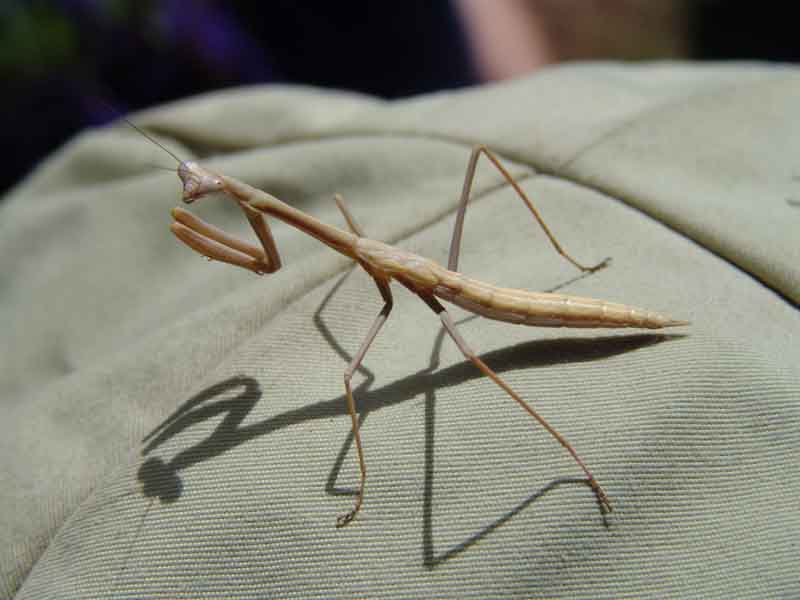
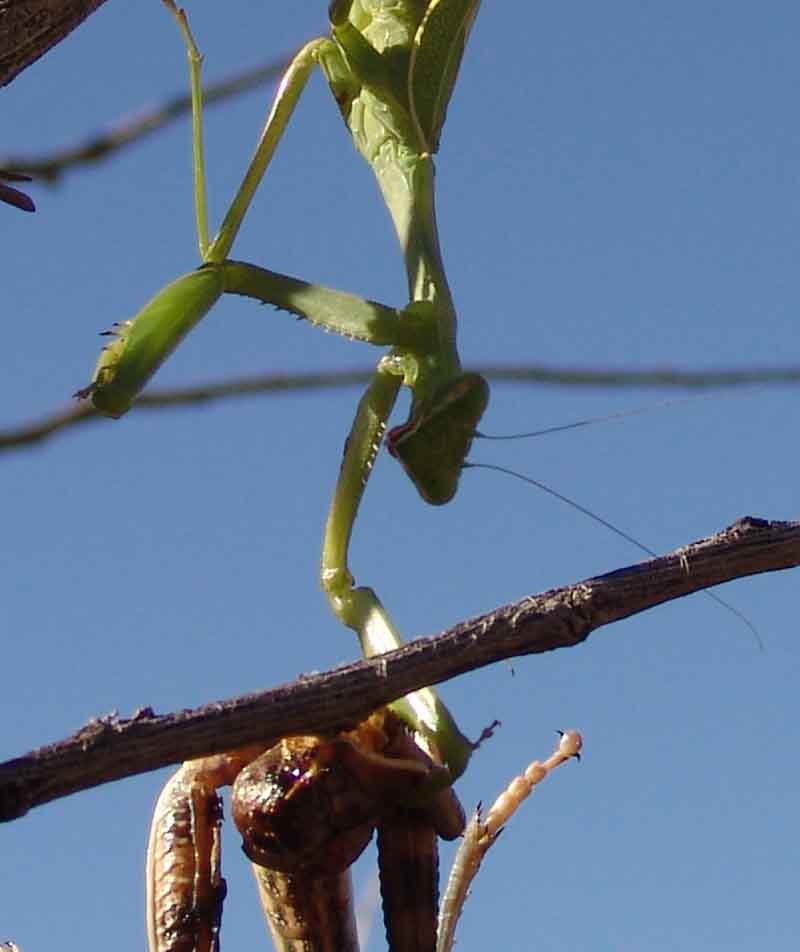 Both the term "Praying" and "Mantis" (Greek: "prophet") refer to the distinctive way these creatures tend to hold up their front legs (as if "in prayer", see both figures in the banner photos above). The Order includes 8 Families and some 2,000 species (20 or so in the U.S., but only two are commonly seen here -- most are found in the Tropics), with a wide variety of shapes (mostly quite elongate). The (unique) common features are a highly mobile, triangular head with large, forward-facing eyes, and prothorax (the first of the 3 thorax segments) elongated to form a "neck", with the two front legs modified for catching live prey. Their antennae are threadlike. The mobile head has eyes that enable true binocular vision. Mantises pounce upon and seize their prey (both herbivorous and carnivorous arthropods, including their own species) very quickly. (McGavin, cited above, p. 71)
Some entomologists group Mantises within the Superorder Dictyoptera ["network-wing"], which includes Cockroaches and (more remotely related) Termites, but so far the Mantids are under-researched, and their fossil record is both scanty and recent (Cenozoic).
Mantids are behaviorally much more complex than researchers once thought. They are "capable of integrating much detailed information from their environment and have exhibited an astonishing array of responses to stimuli" (Hurd, cited above, p. 676). At left, a mantis threatened by a huge intrusive camera in September 2004 in Hot Springs Canyon moved to escape this threat, but resolutely declined to let go of the grasshopper it had been eating. (Click on the image for a close-up view.) Mantids are ambush or slow-stalking predators, waiting motionless for the prey to get close enough that they can strike out with their forelegs.
Sexual behavior is spectacular and often fatal for the male; "a hungry female may decapitate and partially consume a male during copulation without interrupting the transfer of sperm." (Ibid.) The mating season occurs at the end of the growing season, when alternative prey have become scarce and the female needs to gain mass so she may produce viable eggs.
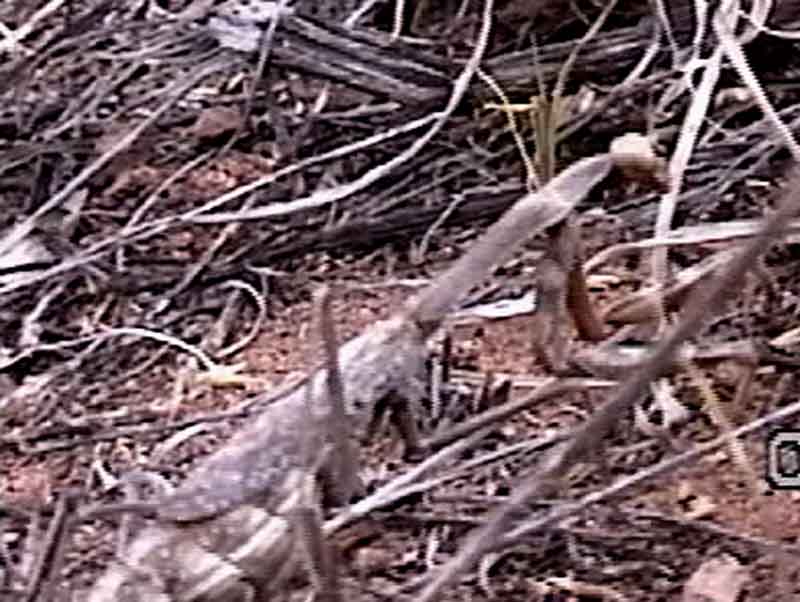
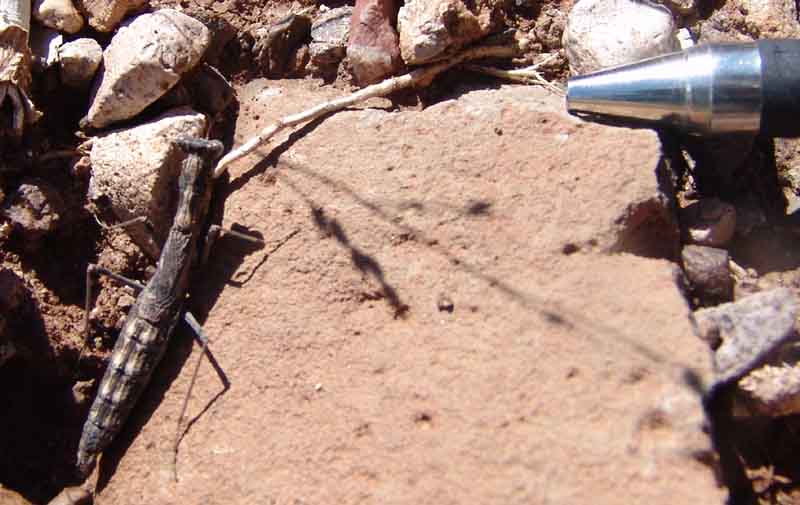
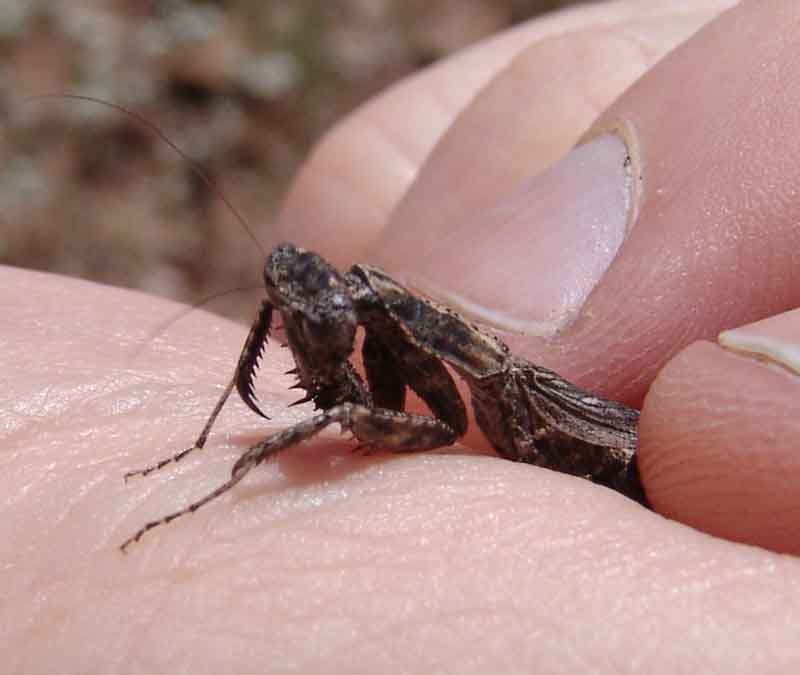
Below, we think that these maybe examples of the Obscure Ground Mantid (Litaneutria obscura), at left, photographed in October 1999, probably a male since the female has much smaller wing-pads. This one was quite large, though we neglected to measure it. Below center, a much smaller, young specimen (perhaps of a different species?), photographed in September 2006. The chrome tip of the pen at right is 22 mm long. Below right, the same animal held in a position to provide good views of the raptorial-grasping front legs, including the sharp spikes used for seizing and holding prey. (Click on each image to enlarge it.)
 .
. ..
..
Praying Mantises are active mainly in warm rainy periods, when prey is abundant and active. They may remain dormant during drought periods. Their food is mainly ants and other insects moving on ground and in low vegetation. (Milne & Milne, cited above, p.396, plate 301.
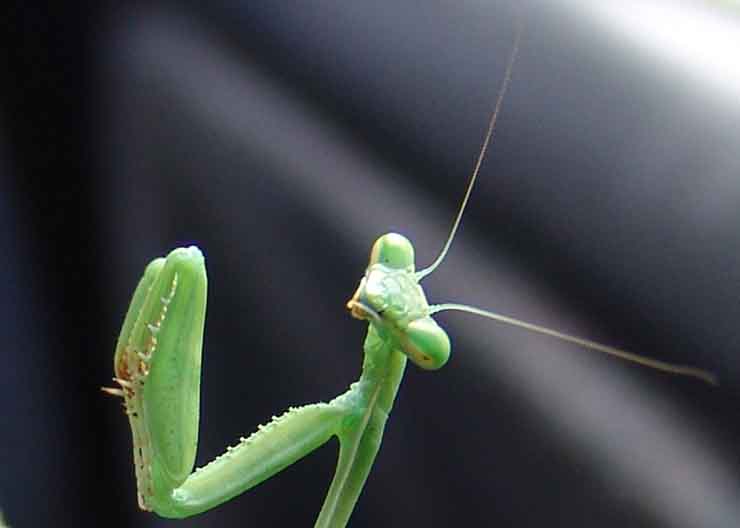
Below, these two were sighted when they landed on automobiles. (Click on each image for close-ups of head and forelegs.) The close-ups show the head and compound eyes nicely (though the figure at left has what appears to be an injury to the right eye) In the close-up at right you see what appear to be "pupils", dark spots on the eye that seem to move with movements of the observer. I am informed by Thomas Kluyver however that "insect eyes do not have real pupils. The dark spots are an optical illusion, called a pseudopupil, a result of the way that light reflects from the compound eye. It will always seem to be looking at you." (personal communication -- thanks to him and the Encyclopedia Britannica for this information.)
 ...
...
Below, photographed along the San Pedro River in April of 2005, this one may repesent another species. It also shows the "false pupil" clearly. Click on the image to enlarge it.