Millipedes (Class Diplopoda)
Millipedes are Arthropods, but distinctively they are myriapods (a separate subphylum characterized by the body plan of head followed by elongated body with many legs), and among this set of 4 taxonomic classes they are diplopoda 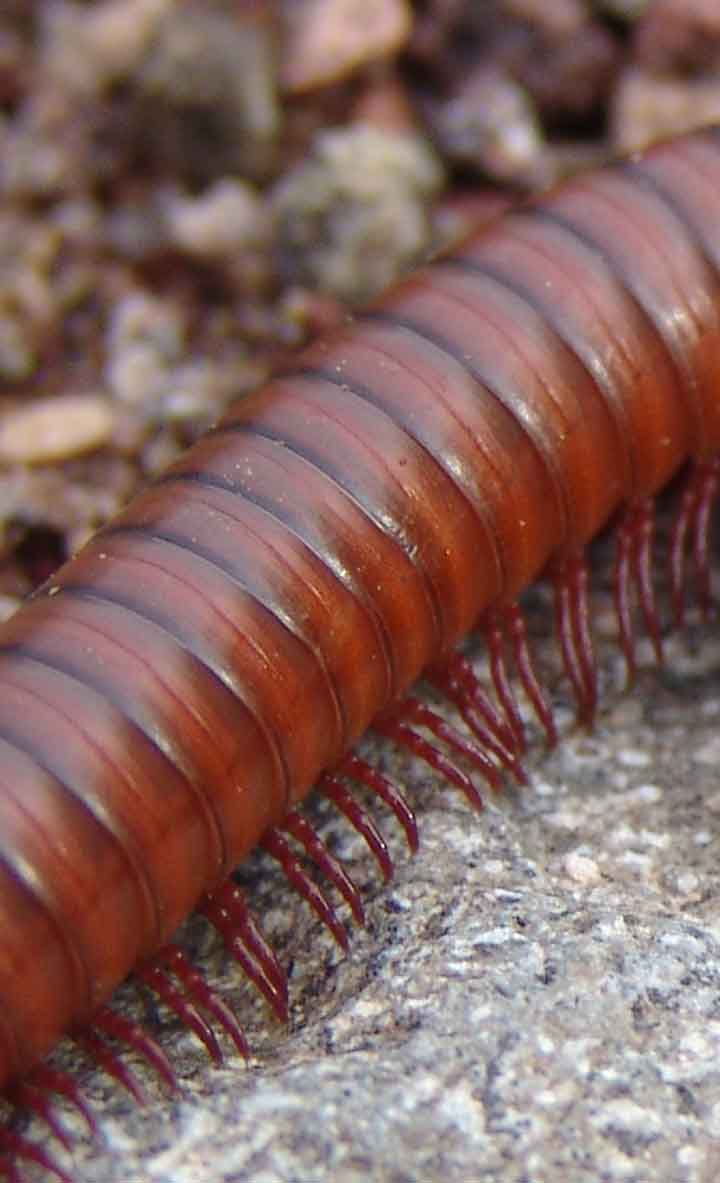 -- they have two pairs of legs per body segment, each diplopod segment being actually two segments fused together -- see image at left -- click on the image to enlarge it, except for the head segment (which lacks legs, but contains antennae, a simple jaw structure, and very simple eyes) and the first three body segments (which have one pair of legs each). Each diplopod segment contains two pairs of nerve ganglia and two pairs of heart arteries, and each pair of legs (left and right) have their own set of muscles and move in synchrony, slightly out of phase with the pair in front and the pair behind and generating a characteristic wave effect as the animal walks. The total number of legs on a particular specimen can be calculated: count the total number of segments, multiply by 4 and subtract 10 -- it will never total the imagined 1,000 but in some species gets impressively close (as many as 750 or so in some species). Millipede legs are structurally more complex than those of insects, and they use this large array to push themselves down into the earth. While their overall movements with these many little legs are slow, they can burrow underground head first with considerable power.
Most millipedes feed on decaying plant materials, moisturizing the material with secretions and then scraping it in with their simple jaws. In doing this, they contribute quite considerably to recycling soils (comparable to the work of earthworms).
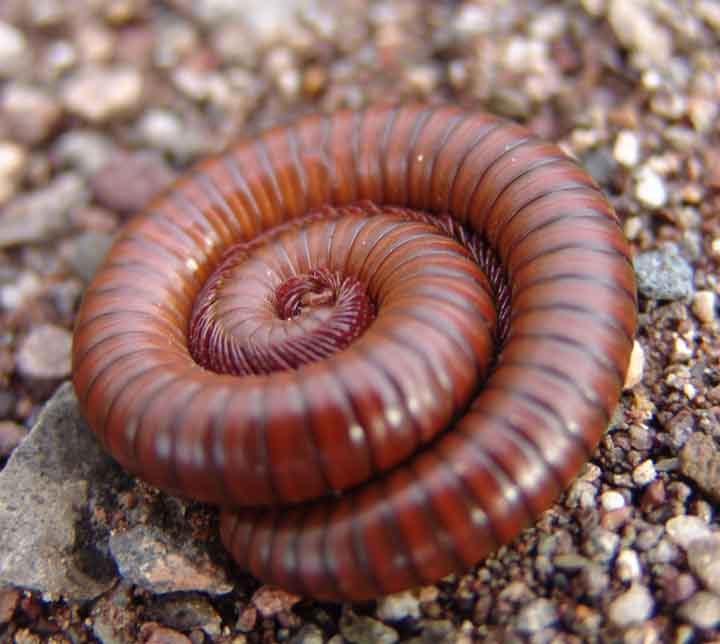 They use calcium to make their exoskeletons hard. Most are nocturnal, and if accosted they do not bite -- unlike their Myriapod relatives the Centipedes, they lack any kind of venomous bite, but coil into a tight defensive spiral as shown by the creature at the right. Click on the image to enlarge it:
However, many millipedes do excrete a poisonous fluid from defensive glands located along both sides of their bodies (hence perhaps the function of the coiled position shown here). Some of these fluids are apparently acidic and can burn the exoskeletons of insect predators and the skin and eyes of larger predators, and in some millipedes the excretions actually contain cyanide. Millipedes should not be casually handled! However, it is no accident that they appear to be shiny-clean -- they spend considerable time cleaning all their body parts.
Diplopoda are thought to have been among the very first animals to colonize the land, during the Silurian period of the Paleozoic Era (440 to 410 Million years ago), and at some later periods ancestral millipedes became the largest land-dwelling invertebrates ever, like Arthropleura fossils of the Pennsylvanian Period (some 300 MYA) found in Illinois -- more than 7 feet long and more than a foot wide.
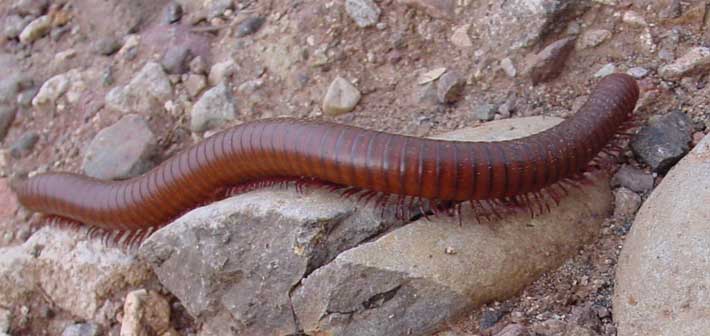
The millipedes of our area are much smaller, as seen in the accompanying images. (The one shown in the banner image at the top of the page was about 4 1/2 inches (11 mm) long.) We usually encounter them shortly after summer rains, as this one below, seen (among quite a number of others) on the rocky lower flanks of Sierra Blanca on July 31, 2003. Click on the photograph for a close-up view.