


Spiders (Arachnids, Order Araneae)
Our aim here is merely to document some of what we see in our part of the Southwest. For much more knowledgeable, systematic, and image-rich sources on the Arachnids, see such links as the Tree of Life -- The University of Arizona's outstanding website, which includes phenomenal coverage of spiders. Go to the page there on Arachnology and you can access more information and images about spiders than you are ever likely to desire. The UC Berkeley Systematics site on the subject is also useful. For more details on our sources, see the main Arthropod page. We also used Merlin, Pinau, 1999, A Field Guide to Desert Holes, Tucson: Arizona-Sonora Desert Museum Press.
More than 3,000 species of spiders have been identified in North America, and they live almost everywhere. Spiders are distinguished by possession of 4 pairs of 7-segmented legs. Unlike insects, but like other Arachnids, spiders have only two major body sections -- a cephalothorax and abdomen, but unlike fellow-arachnid scorpions, mites, and daddy-long-legs, their two major body segments are separated by a "waist". Both features are somewhat visible in this image, below, of a male Tarantula crossing the broad expanse of Teran Wash searching for a mate after sunset, the day following the wash-flood of August 28-9, 2002. Only males do this kind of nocturnal wandering. Males also have distinctively reddish abdomen hairs.

(Click on the image to enlarge it.)
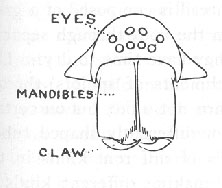
A spider's mandibles are located close together at the front of the head, and are composed of a sturdy basal joint and an end-joint or claw which is slender and sharp-pointed, and which contains at its tip the outlet for the poison gland. The eyes are located on the front of the head, usually 8 in number, differing however in size and number depending on the spider, see drawing at left.
Tarantula (Aphonopelma chalcodes):
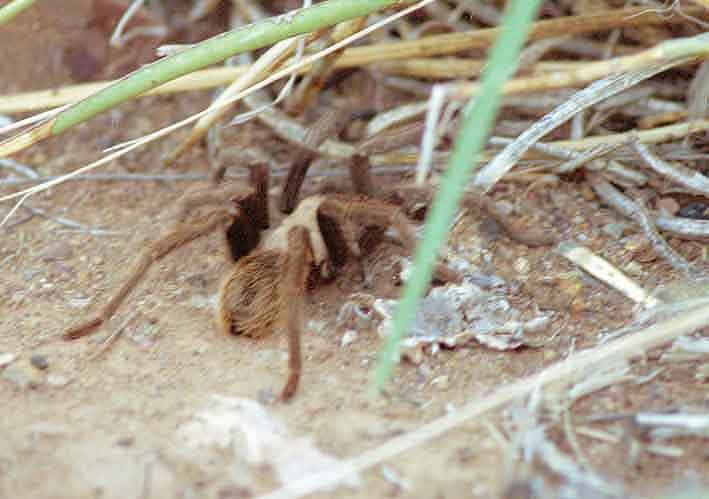
Below, these two Tarantulas could be the same creature -- the left-hand photo was taken in September of 1997, the one on the right in September of 1998, both photos taken around sunset, near the creature's hole at Hunters Camp: (Click on these images to enlarge them.)
 ..
..
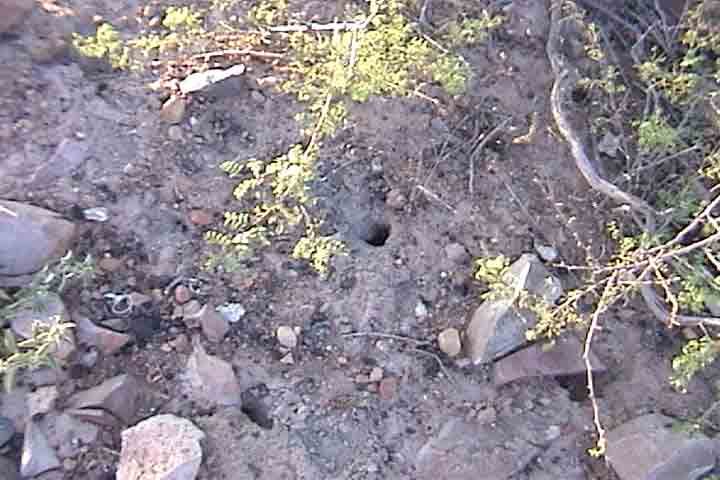 At left, this same creature's hole. (Click on the image to enlarge it.) These holes are about a foot deep, and are lined with an inconspicuous silk, strands of which extend out from the hole (though very hard to see), serving as sensors of passing prey (insects, lizards, and other small animals). Females stay inside their nests more than do males (see the image), though both hunt mainly at night. Tarantulas have very tiny eyes and poor vision, depending primarily on vibration-sensing. The females may live as long as 20 years, while males live 10-13 years.
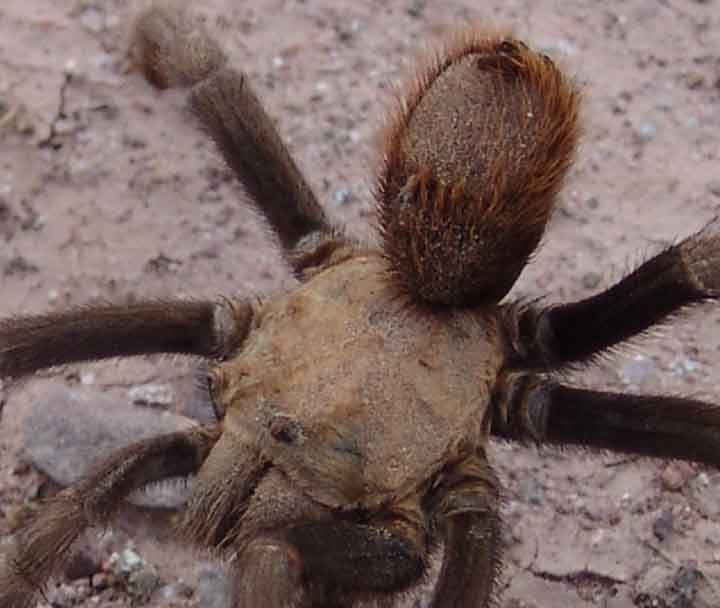 The hairs on Tarantula abdomens include "urticating" (irritating) hairs which they loosen with their legs, and which protect them against many kinds of predators, who find the hairs very painful when lodged in their eyes, throats, or nasal passages. Coatis, however, have learned to grab tarantulas and roll them vigorously in the dirt, dislodging the urticating hairs and leaving the predator with a nutritious and tasty meal. Tarantulas are also vulnerable prey to the Tarantula Hawk, the largest spider-hunting wasp in the world, which conspicuously frequents our deserts in the summer months. At right, this particular tarantula, encountered in Sierra Blanca Canyon Wash in October 2005, raised his abdomen up high, toward the encroaching photographer, thus displaying the urticating hairs very clearly. (Click on the image to enlarge it.)
We will try to follow a policy of presenting new kinds of spiders near the top of our page as we encounter them, in order to ensure that viewers will see them and (hopefully) give us guidance in identification.
Western Spotted Orb Weaver (Neoscona oaxacensis)
(Thanks to amateur naturalist Pat Goltz for guiding us in this one.) Anyway it's appropriate to put Orb Weavers near the top of our page since the family Araneidae is considered the third largest of Spiderdom (behind Salticidae and Linyphiidae). Identification of species is often based on specifics of web construction.
This spider we saw near twilight on August 31, 2008, along the guide-ropes of a lean-to in Lower Hot Springs Canyon: (click on the image for a larger & better view)

Our first image used flash-assist, when the spider was at web-center, and we could tell it was an orb web but the image was poor. (As we tried repeating, it moved to the peripheries of the web where we got the image above.) So when we returned in the morning of September 3 we checked on this webmaster and saw it occupying the center in the image below, here with a good ventral view: (click on the image for a larger & better view)
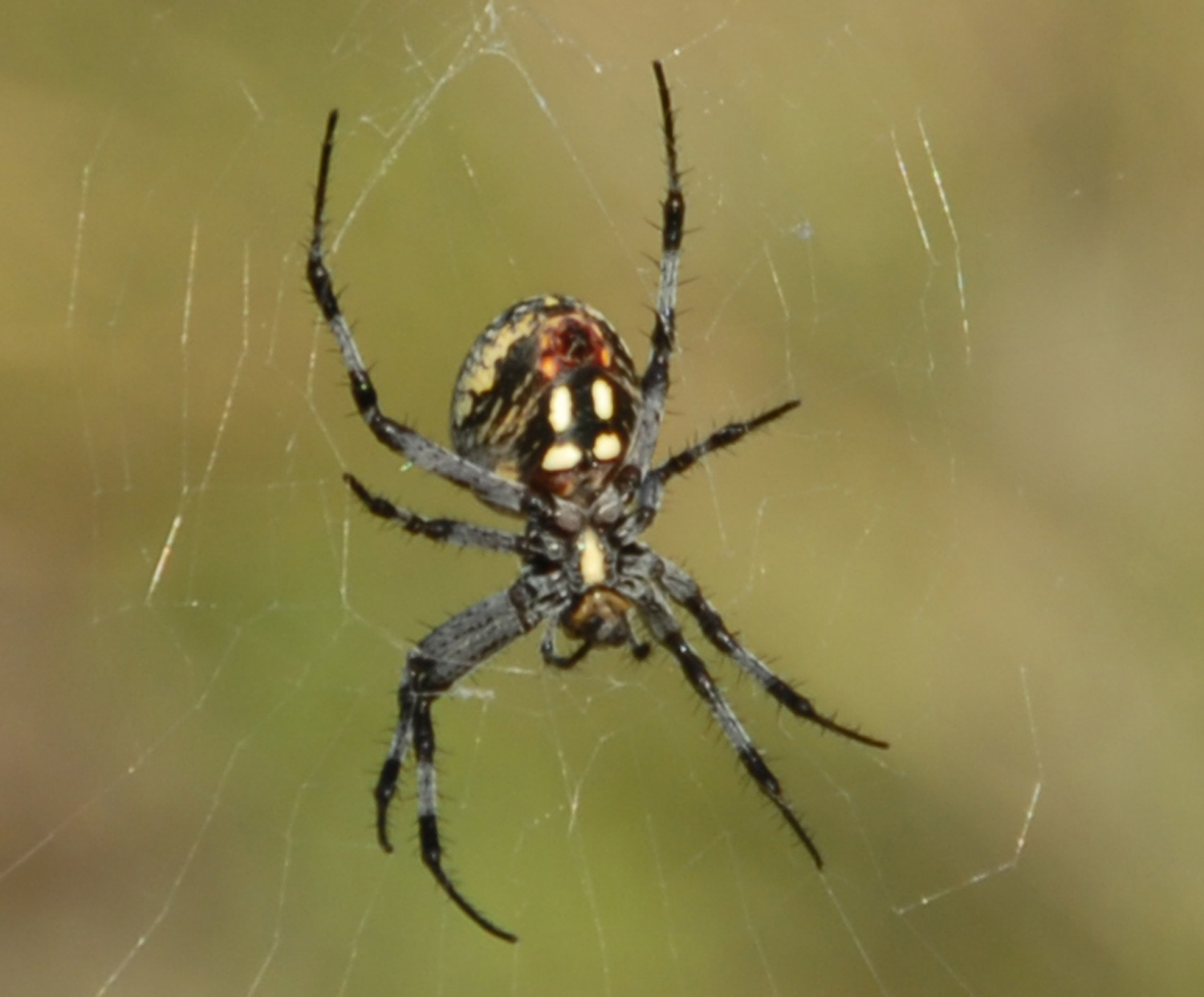
FYI, in another ventral view from a slightly different perspective, the medial portions of the darkish underlegs had a reddish cast. A quick survey of the web suggests this is a member of the genus Argiope, commonly known as "Garden Spiders".
This was a master of the orbital web. We tried several views, but perhaps this one shows the construction at its fullest, in a strongly filtered image:

Black Widow (Latrodectus mactans)
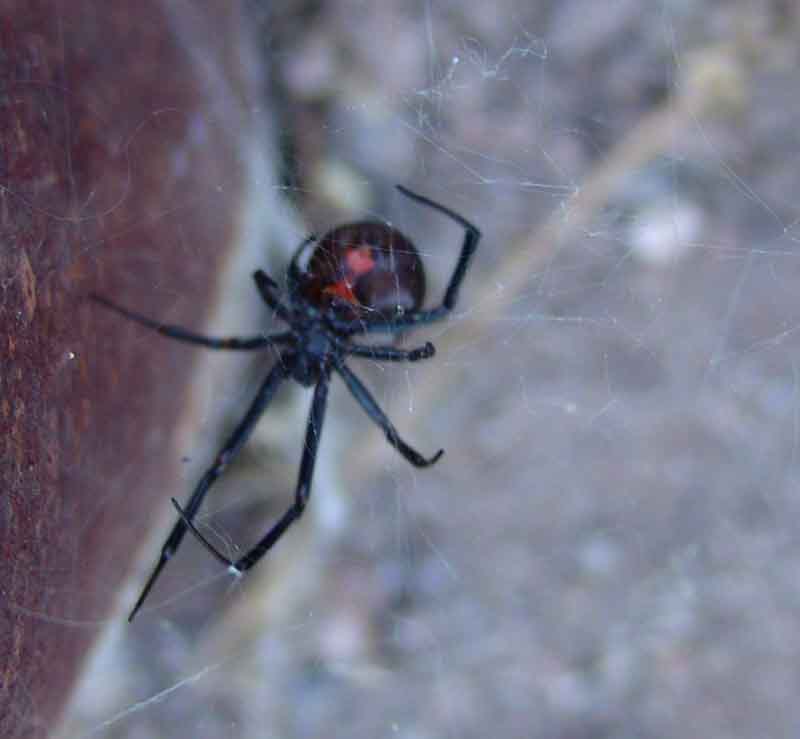
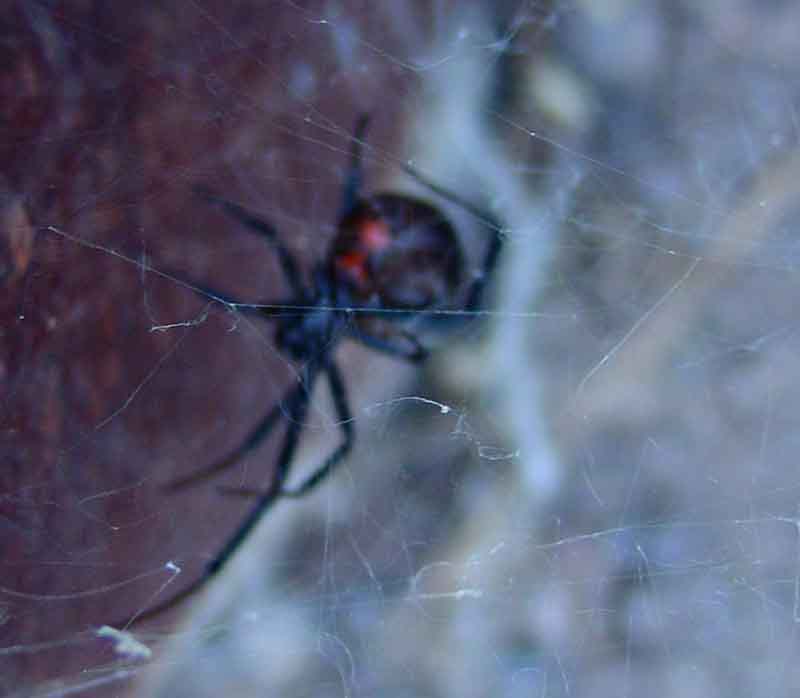
These "Cobweb Spiders" are found worldwide in tropical and subtropical countries. This one below was seen within its web in October 2006, inside a well cap that had been entirely covered by a large galvanized barrel. (We found another one hiding beneath a fist-sized rock nearby.) Typically nocturnal in their predation, they form very irregular webs, tangling strands of which can be seen in these images, and mostly wait for their prey but may also hunt on the ground. The bright crimson "hourglass" marking on the underpart of the very strongly rounded abdomen is typical for the female Black Widows found in our area. Their powerful venom can be fatal to children. (Click on each image to enlarge it.)
 ...
...
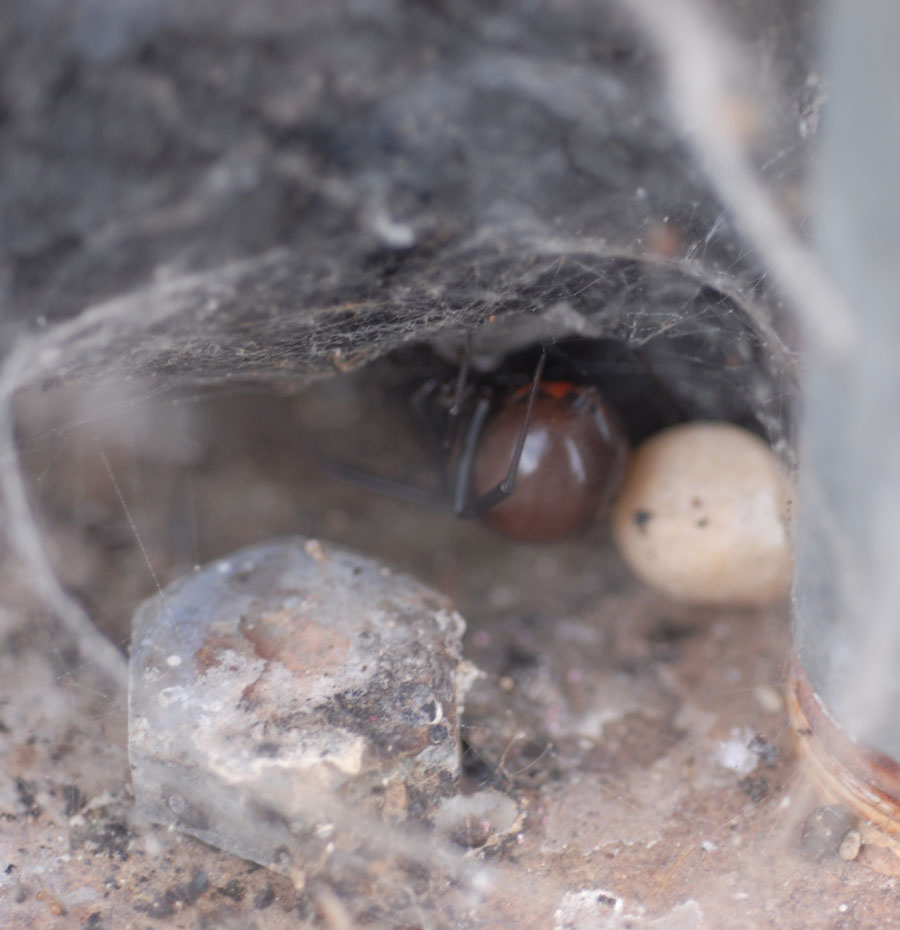
Below, on March 13, 2008, this may be the same Black Widow spider (in the same location), now tending one egg sac while (apparently) about to produce another. (Click on each image to enlarge it.)
 ..
..
Below, revealed in an overturned camping table in August 2002, a Black Widow tends her egg sacs inside her web. (Click on the image to enlarge it.)

Brown Recluse Spider (Loxosceles spp.)
(also known as "Violin Spider")
While we have not yet obtained a photograph of a Brown Recluse spider in our immediate area, the venom of the Brown Recluse is sufficiently harmful that a photograph below obtained by Michael and Nicole Freeman in Tucson on April 2, 2008 (and thankfully, forwarded by them to us) is useful here. (Click on the image for a better quality view.)
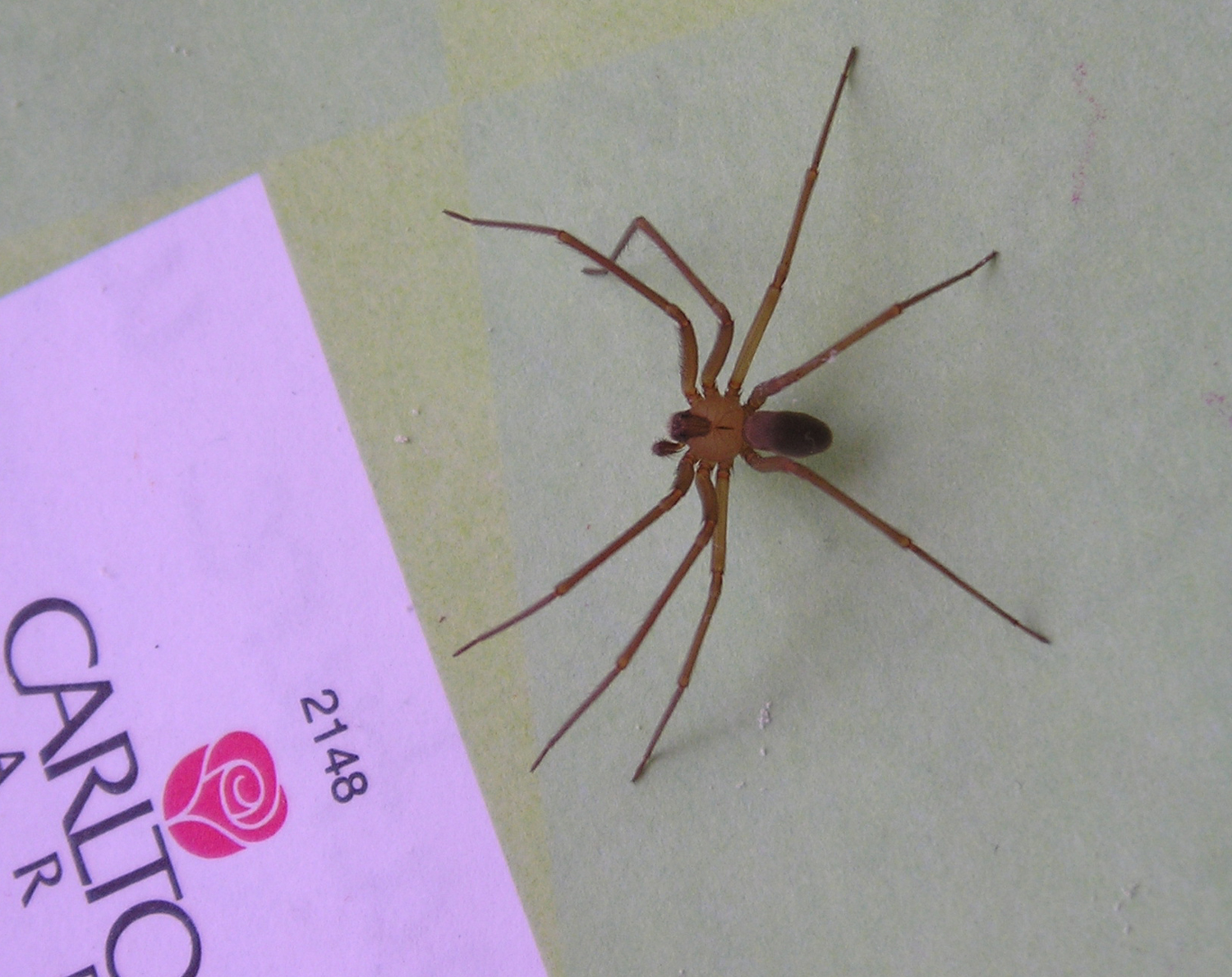
The male spider photographed above is missing his right pedipalp. Males are about 3/4" long, females 3/8". The orange-yellow cephalothorax is characteristic, as is the so-called "violin" pattern you see there (which however is not so definite in some southwestern species). Loxosceles spiders are publicly defined mainly by Loxosceles reclusa, a species of known severe toxicity whose distribution is apparently east of our area (see BugGuide Distribution Map, thanks Nicole Freeman!), and the toxicity of the other species that do center in our area has apparently not been fully defined. In any event, the Brown Recluse often lives in and around human housing. As Milne & Milne (1980, p. 876) observe, "This spider sometimes takes shelter in clothing or a folded towel and bites when disturbed. The wound commonly develops a crust and a surrounding red zone. The crust falls off, leaving a deep crater, which often does not heal for several months." (However, the effects can be more severe for children, the elderly, or the ailing. See various sources in the Worldwide Web for more details on this spider.)
Funnel Web Weavers (Family Agelenidae)
In our area, funnel weaving spiders seem to become most conspicous when they first become active in the Spring -- both these images below were taken in May, when such webs seemed to be everywhere.
 ...
...
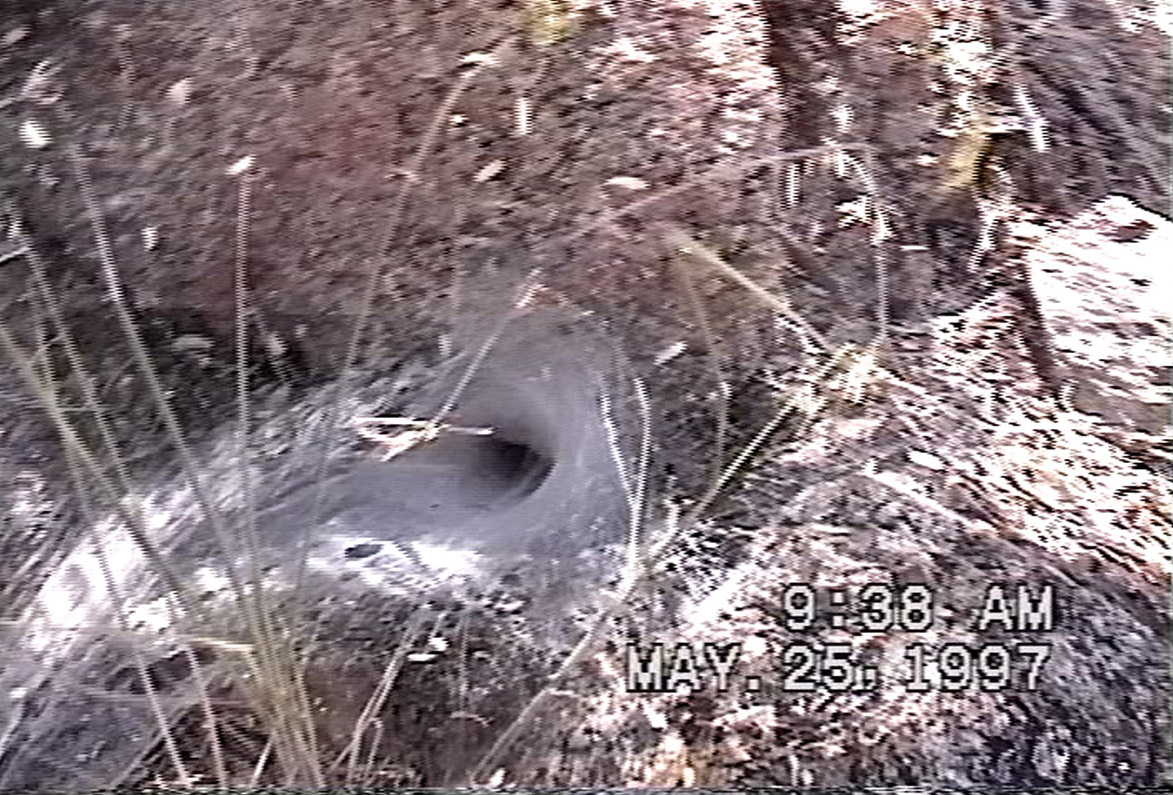
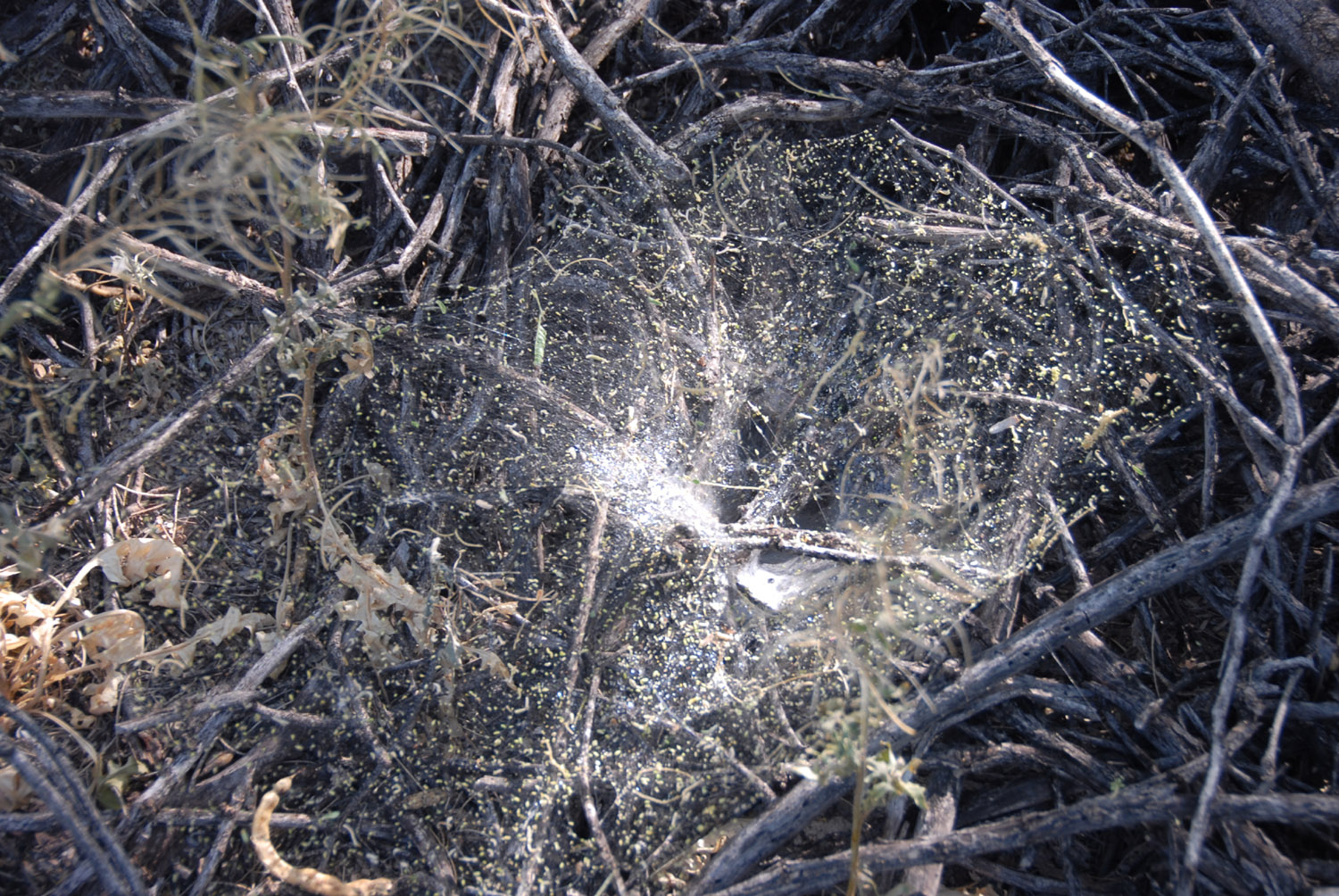
The webs themselves are constructions of rare beauty, evident even in such crude images as the one below left, taken with a cheap camcorder in May of 1997, or with a better still camera below right in May 2008, where the web is dappled with fallen mesquite duff: (Click on each image to enlarge it.)
 .
.
Here, below, is an image of a Funnel Web Weaver occupying a stack of old straw bales in Lower Hot Springs Canyon in September of 2003:
(Click on the image for a closeup)

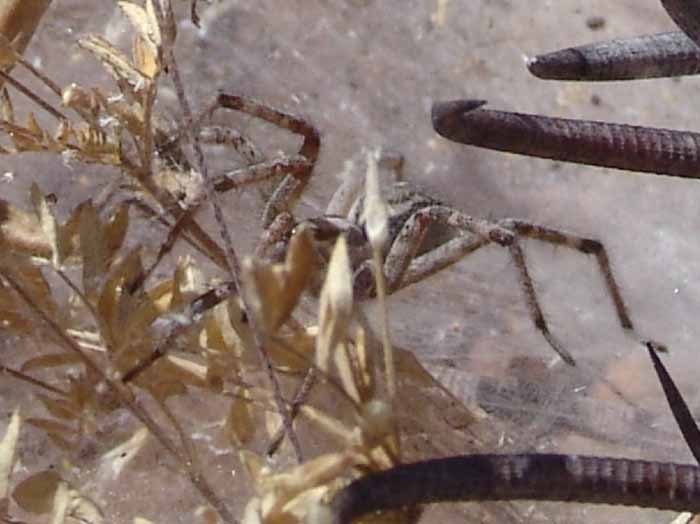
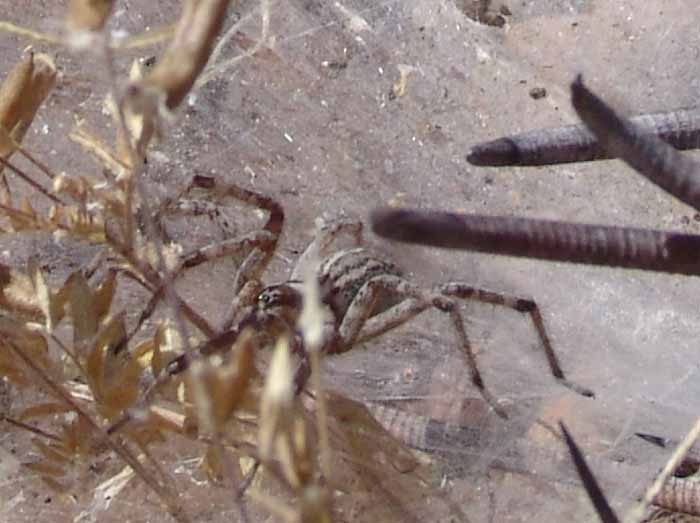
Here are slightly better images of another individual from the same area, from May of 2004: (Click on each image to enlarge it.)
 .
.
Amateur naturalists Michael and Nicole Freeman have shared with us this good closeup of a funnel-weaver spider in Tucson, taken April 30, 2008: (Click on the image to enlarge it)
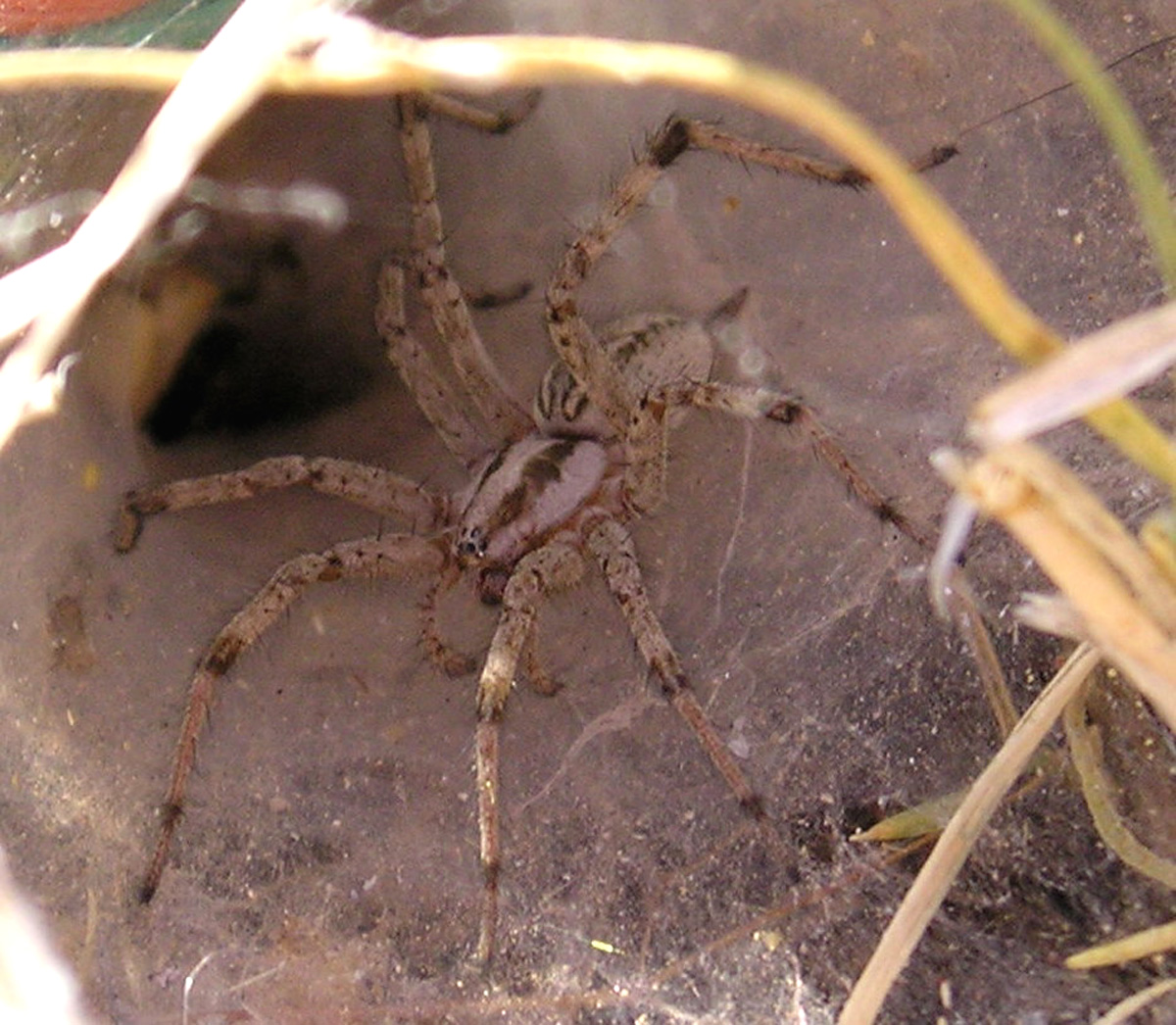
A very good website on Funnel Weavers is maintained by Ed Nieuwenhuys of the Netherlands -- see this link: Agelenidae(This focuses mainly on Funnel Weavers of NW Europe.)
Filistatidae (Crevice Weavers)
We encountered this spider below inside a house on a terrace of Lower Hot Springs Canyon in September of 2003. The white surface is vertical tile and the "funnel"-like web hole is out of view above, at the joint between the tile and the wood. A nightlight in the room no doubt kept this denizen fed. The funnel-like opening led us to suggest this might be a Funnel-web spider, but fellow amateur naturalists Michael and Nicole Freeman argue it may rather be a member of the genus Kukulcania , perhaps the "Southern House Spider" (sp. hibernalis). (Click on the image for a closeup of this remarkably beautiful creature!)

Looking through websites describing Kukulcania species, we think they are probably right concerning the genus anyway. The Filistatidae are a family of "crevice weaver" spiders (see that link), who weave funnel- or tube-like webs, but the web structure is very different from those of true funnel-web spiders. (You can see the overall pattern clearly here, and in the closeup image as well.) Unfortunately, we cannot say more about this particular spider, since it was killed sometime after the photgraph was made. Since it inhabited a recently-occupied house in our area, it may well have been intrusive from another location (though there is an arizonica species in our area that has similar appearance). (See also BugGuide.)
We definitely need to collect more images, specimens, and information concerning some of these spiders before it makes sense to talk more about them in much detail.
Rain Gauge Mystery Spider (seen upon checking exit screen of Sukkah Overlook gauge), below left; the egg sac was stretched across the rain-opening below the screen (below right)):
 ...
...
Jumping Spider (Family Salticidae)
We first encountered this species, below, of Jumping Spider above the Notch in October, 1994. Jumping Spiders have excellent vision, enabling them to see, stalk, and pounce upon prey from a distance. (They can jump more than 50 times their body length.) They are distinguished from other spiders by possessing four big eyes on the face and four smaller ones on top of the head (not evident in the relatively poor images obtained here). Their fine vision is also responsible for the colorful qualities of the type seen here -- evolutionary adaptations for the sexual competition involved in their courtship rituals. Below left, facing toward the videocamera; center, facing away.
 ...
...
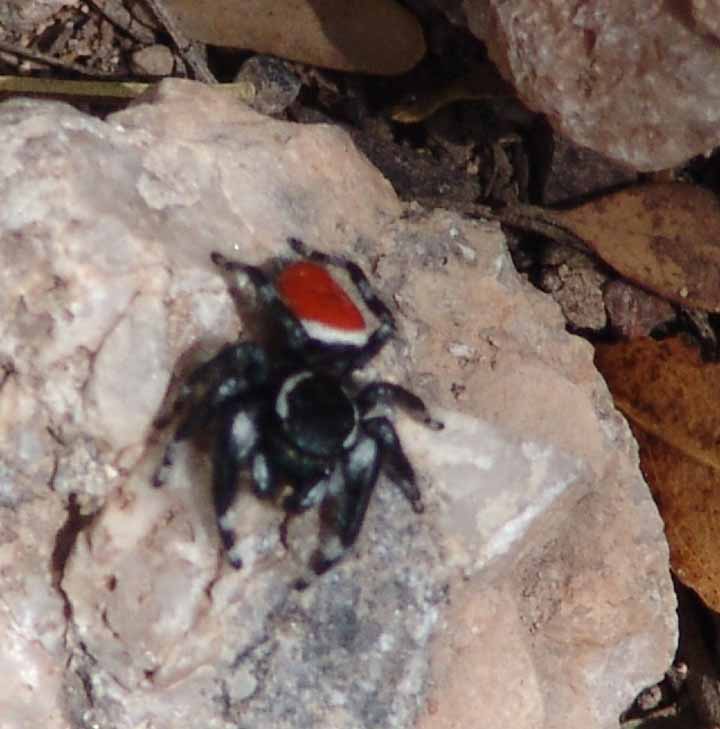 The images above, taken with an old Camcorder, were of rather poor resolution, but in September 2004, we saw a second version at Sierra Blanca Spring, at left, now having a much better camera with which to capture it. (Click on the image to enlarge it.)
According to Wayne Maddison (in the Tree of Life website cited above), "Around the world there are probably more than 5000 species of jumping spiders, of which a few hundred occur in North America north of Mexico." This makes them the largest family of Spiders. Maddison (formerly an Associate Professor at the University of Arizona, now unfortunately for us in Arizona, stolen away by the University of British Columbia) has been building (with his colleague Jerzy Proszynski) a marvelous website reporting on these spiders; see http://salticidae.org/jsotw.html.
On November 06, 2011, we received the following image from Steven Sarns, who had photographed it the previous day in Green Valley, AZ and kindly granted permission for us to display it here. He identified it more precisely than we had done, as the Johnson Jumping Spider (Phidippus johnsoni), and so we went to the website just linked and looked at Phidippus specie. cephalothorax.

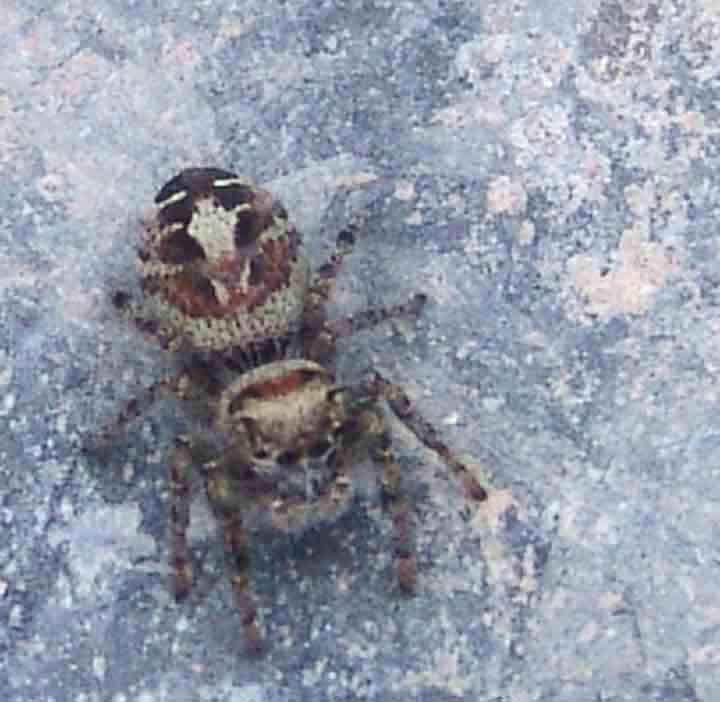
We saw this small hunting spider below -- probably also a salticid -- traversing a flat metal drum on April 23, 2005, in lower Hot Springs Canyon: (Click on each image to enlarge it.)
 .....
.....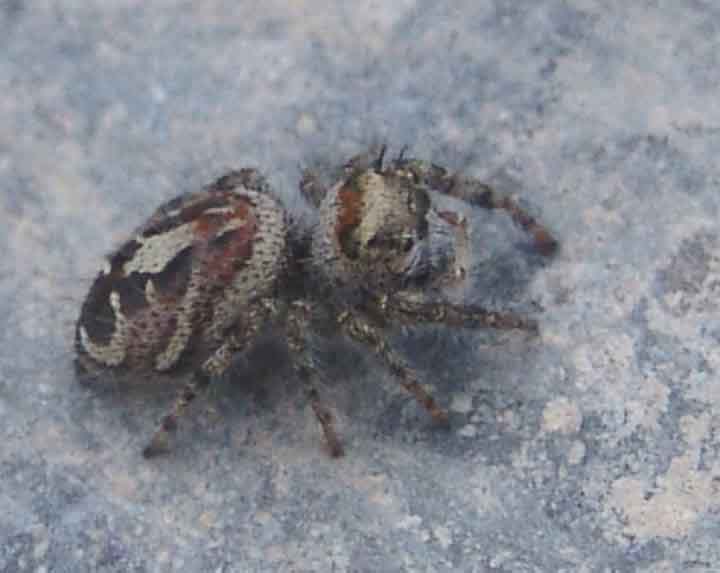
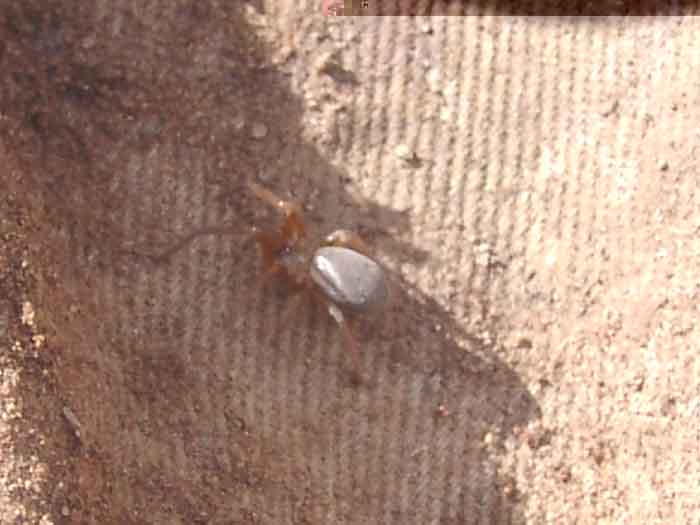
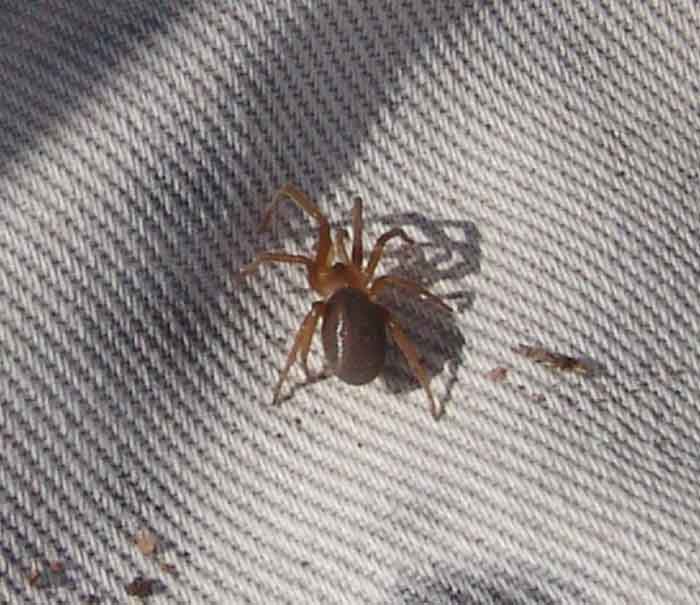
Below, a slightly crisper view of the same species photographed on canvas at the same location in October 2006. The canvas background gives us a size for this spider of almost 10mm length from head to tail. Again, our resolution does not permit identifying the eyes, though perhaps the four small eyes are located near each end of the reddish bar running across the cephalothorax. The two big ones may be discerned in the image above left.

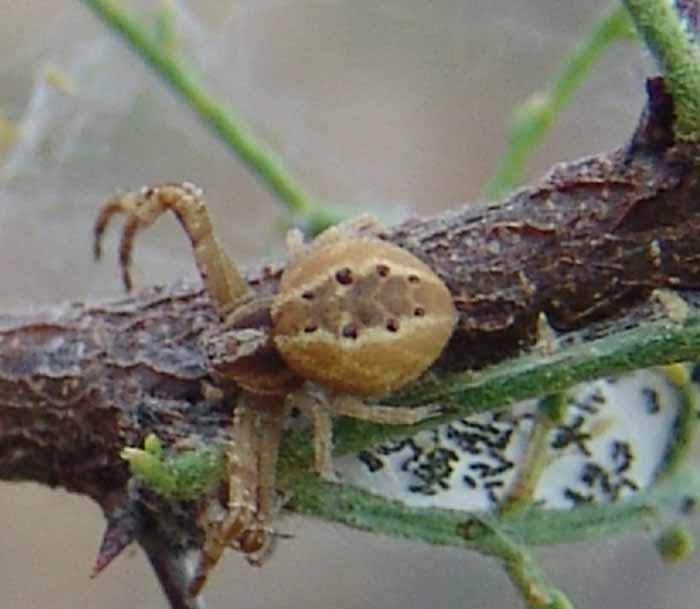
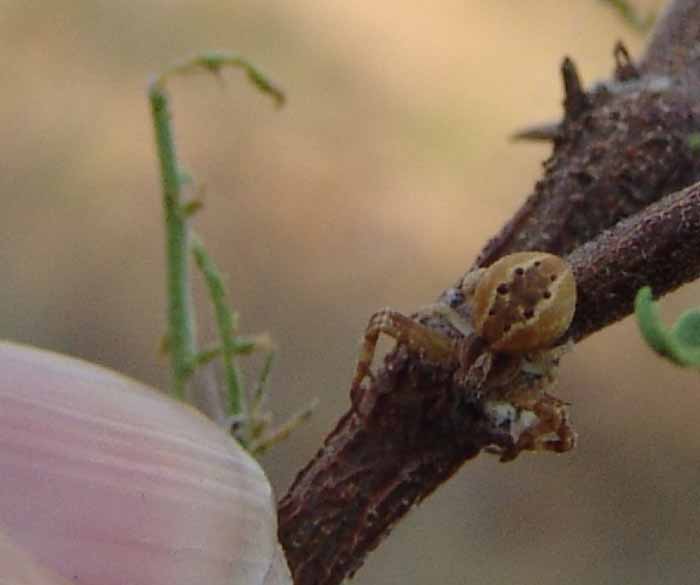
In April and May of 2004, we experienced an infestation of some kind of Acacia blight on Saguaro Juniper lands, due to our good Spring rains. Whatever the infestor was, it formed web-like structures while consuming the new leaves of the White Thorn Acacia (mainly). This infestation in turn drew predators to the scene, and we photographed these two kinds of spiders below: at both left and right, the same kind of tiny spider, whose size can be estimated from the adult thumb-tip seen in the photo at right: (Click on each image to enlarge it.)
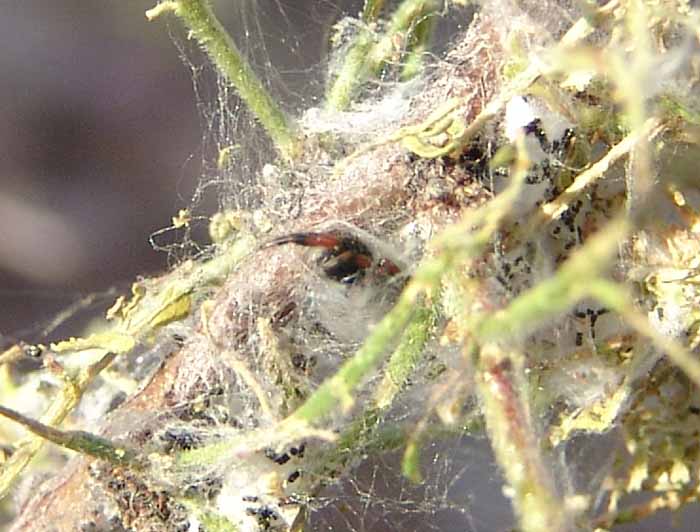
Below, another very tiny spider, this one we think a "Jumping" variety of hunter. It was burrowing down into the web materials, quite rapidly, and hence the images are not very clear: (Click on each image to enlarge it.)
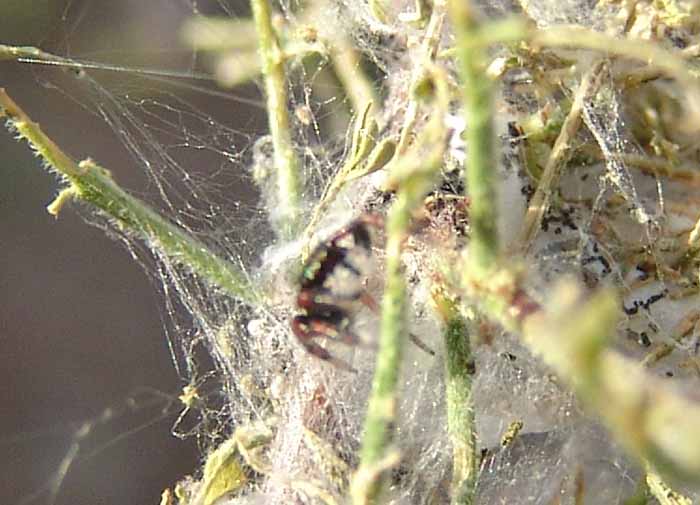
As you can see, this blight was quite destructive of the Acacia leaf systems on some plants.
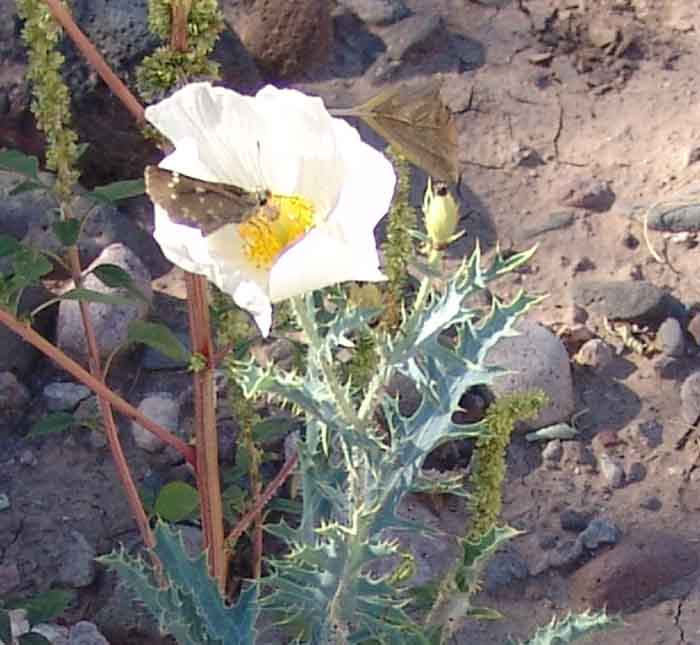
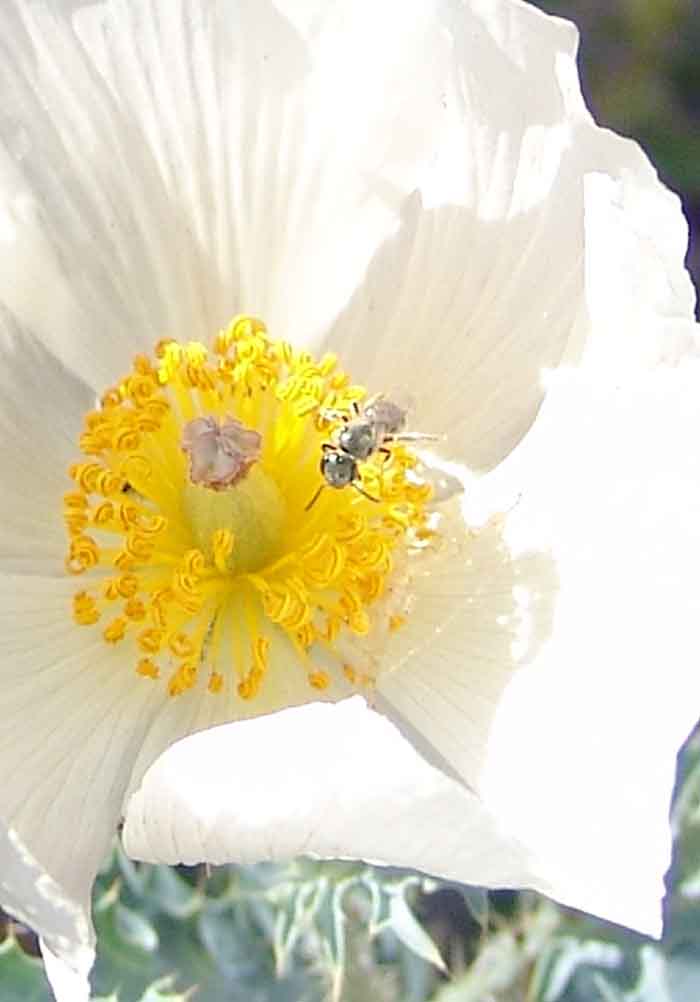
On September 10, 2004, hiking up Lower Hot Springs Canyon after the stream had flooded on September 3, we saw this Spiny Poppy now in full flower, visually brilliant in its white cloak, with a butterfly visiting it. Looking at the flower more closely, we saw other insects visiting the pollen (click on the images below to enlarge):
 ...
...
As we continued to watch the flower, waiting for more insects, we suddenly saw part of the white flower move, and looking closer we recognized a very white spider, searching about the flower for prey (click on the images below to enlarge):
 ...
...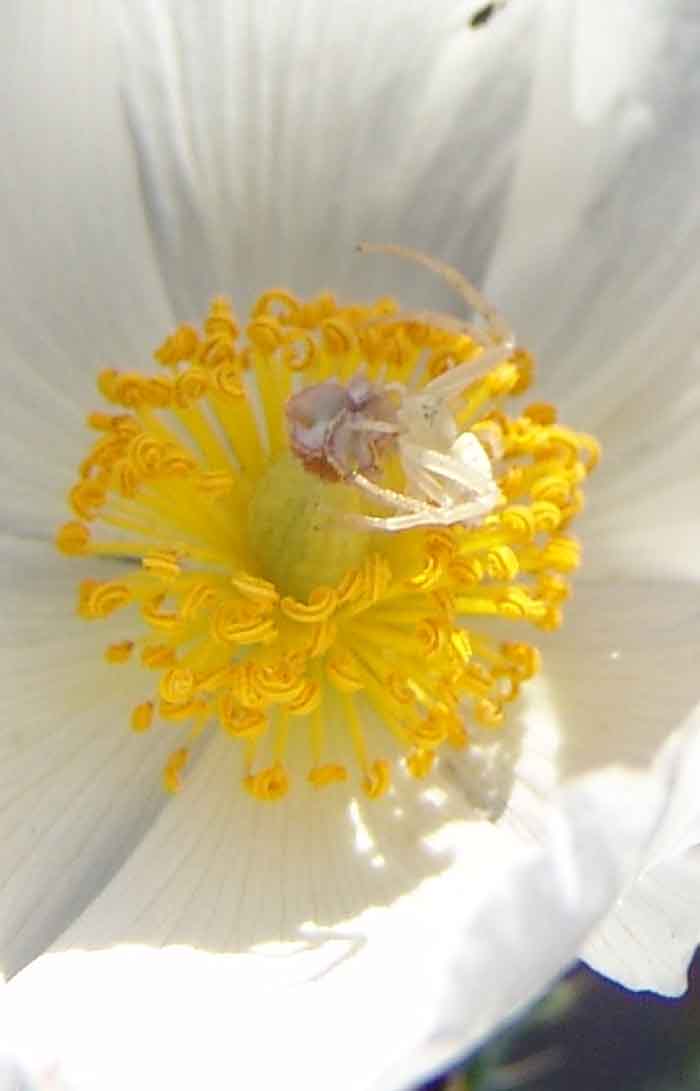
Note what appear to be tiny black eyes. In view of its remarkable color matching with this flower, we wonder if this particular kind of spider has adapted to this coloration, perhaps even to this particular species of flower. (This is no more than an educated guess.)
In April of 2005, we visited a Brittlebush plant in full flower, similarly brilliant but in two tones of gold. Attracted by the brilliant colors, we looked closely, and saw a black-white striped Hover Fly on one flower, but as we prepared to photograph it noticed that it looked odd, as though it had a gold-colored bulb attached to it, which then moved. As we moved closer, we saw it was a spider, who then retreated with its prey, down its silk and seeking refuge behind a leaf on a stem below: (Click on each image to enlarge it)
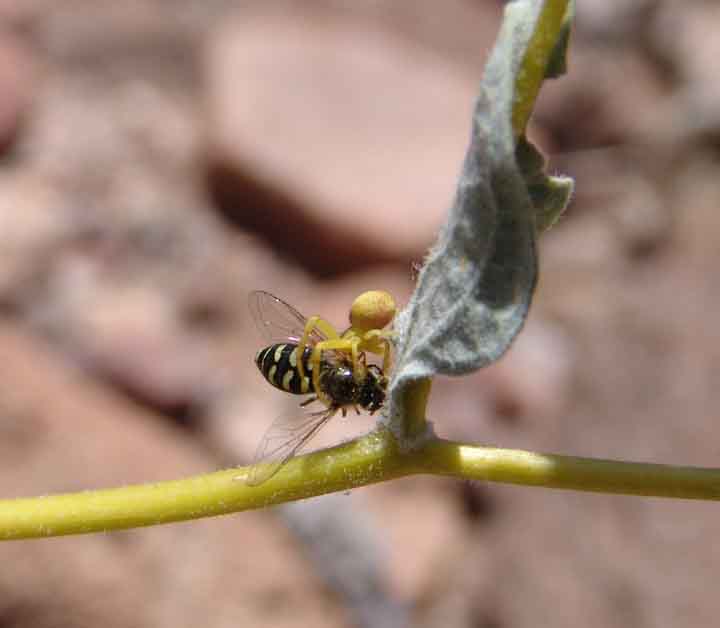 .......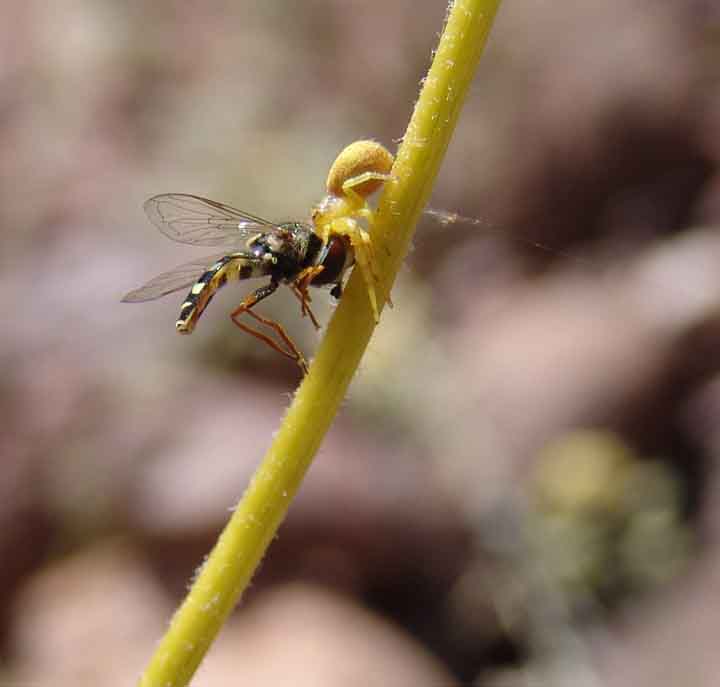
The image at the right shows that the spider has already sucked the Hover Fly's abdomen dry.
We find it most remarkable that, in both images but especially the one on the right, you can see that the spider is two-tone in color, the abdomen a definitely darker gold than the thorax and arms (which are more brightly yellow), and this pattern closely matches the contrastive golds of the flower. See the Brittlebush link above for illustration. Like the bright-white spider previously discussed, this one looks like it could be an adaptive imitation specifically responding to the colors of the Brittlebush flowers, which attract a considerable variety of insects. (Like the other example above, this is just an educated guess.)
In May 2005, while photographing Prickly Pear flowers, we sighted these well-camouflaged spiders on the pads of the plant:

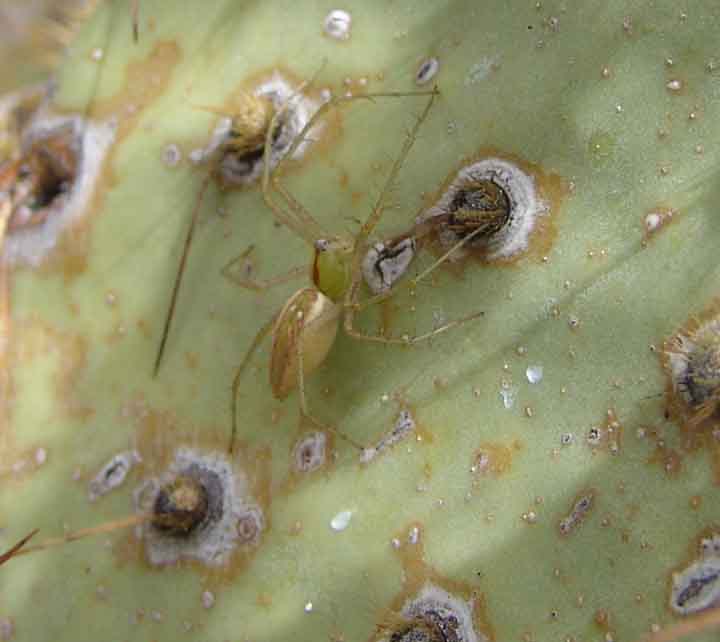
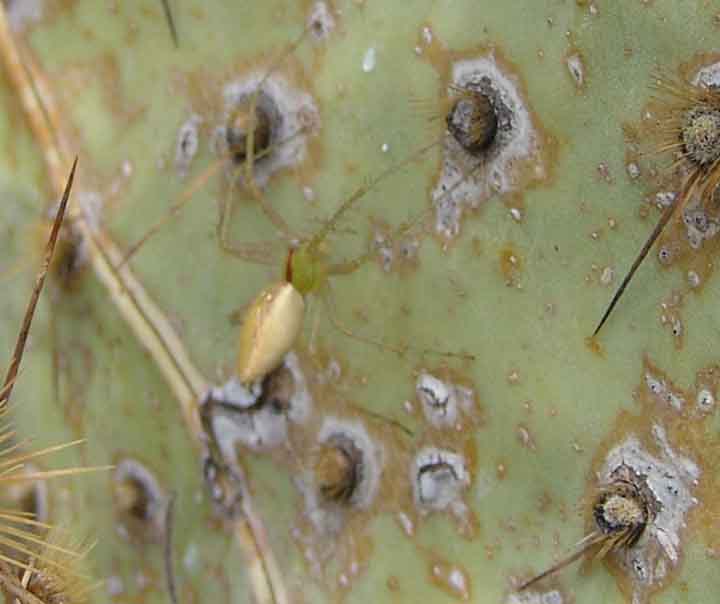
Not easy to see against the background of this Platyopuntia pad, this one stands just right of dead center in the photograph above -- its abdomen mimics the burnt-yellow spots on the pad, its head the pale green, as you can better see in the three images below. Click on each image to enlarge it.
 ....
.... ....
....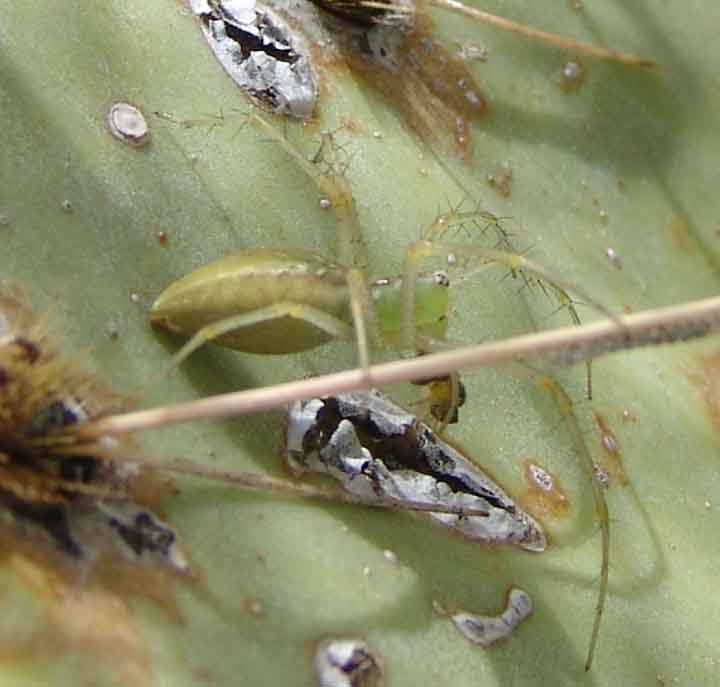
In the image above left, you can see both the green of the cephalothorax and the blotchy burnt-yellow coloration of the abdomen (as well as the long legs); in the middle image the dark-red slash which, interestingly, color-mimics some of the adjacent red spines of the Prickly Pear; on the right, the seemingly translucent pale green of the cephalothorax stands out. This latter was a different specimen than the one shown in the other images, found with its abdomen swelling up while it was consuming a smaller insect (the dark blotch just visible behind the large pale beige spine of the cactus). It seems likely that the color patterns in this arachnid case (as also in the previous two examples discussed further above) are confusing primarily to the spider's potential predators (who, like us, will see it mainly from above).
In January 2005 we saw this hunting spider, below, in the rich mix of creatures occupying the previously hidden microhabitats of a Packrat nest we had decided we had to disturb. It was hiding beneath the canvas tarp you see here, first seen at left when the dirty side was exposed, it was then shaken onto a cleaner side: (Click on each image to enlarge it)
 ..
..
Some large slabs of lumber and of saguaro ribs were lying in the same area, and when we turned them over we found both numbers of tiny Gnathamitermes termites with their mud nests, actively feeding there, and smaller numbers of creatures we were inclined to call "Daddy Long-legs". We have seen such creatures inside houses around Cascabel, and so we were eager to get pictures. Below, a photo showing the habitat. Note the webs in the vicinity of the mud constructions of the termites. A single individual of the type creature is visible just below center in the photograph. (Note also the spider-webbing and the remnants of the termites' mud nests just above it.)

Cellar or "Daddy Long-legs" Spiders (Family Pholcidae)
But these are "Daddy Long-legs Spiders" (unlike some Arachnids who bear the popular name "Daddy Long-legs", which are rather "Harvestmen", members of the Order Opiliones, who lack the slender waist between cephalothorax and abdomen -- see Gavin, cited on main Arthropod page, pp. 221-2). Daddy Long-legs Spiders belong to the family Pholcidae, having their 8 legs attached to the cephalothorax and a separate abdomen. These spiders (who are found worldwide) possess a neurotoxic venom and the ones we see here no doubt prey on the termites, which they envelope in silk before administering the deadly bite. They build irregular silknets, where they rest hanging down, waiting for their prey. They are active throughout the year.
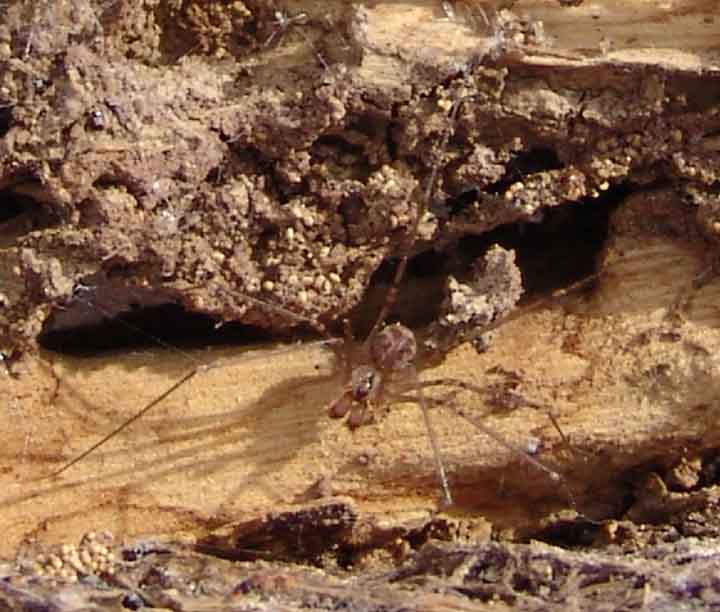
Below are photographs of three individuals observed scrambling around this general surface. That they were actively feeding and growing is suggested by the presence of discarded exoskeletons in two of the photos.
(Click on each image to enlarge it.)
 ..
..
Note in each of the previous images the stalk separating carapace from abdomen. Note the webbing in the right-hand photo.
The image below is our best so far of an individual specimen. (Click on the image for a closeup)
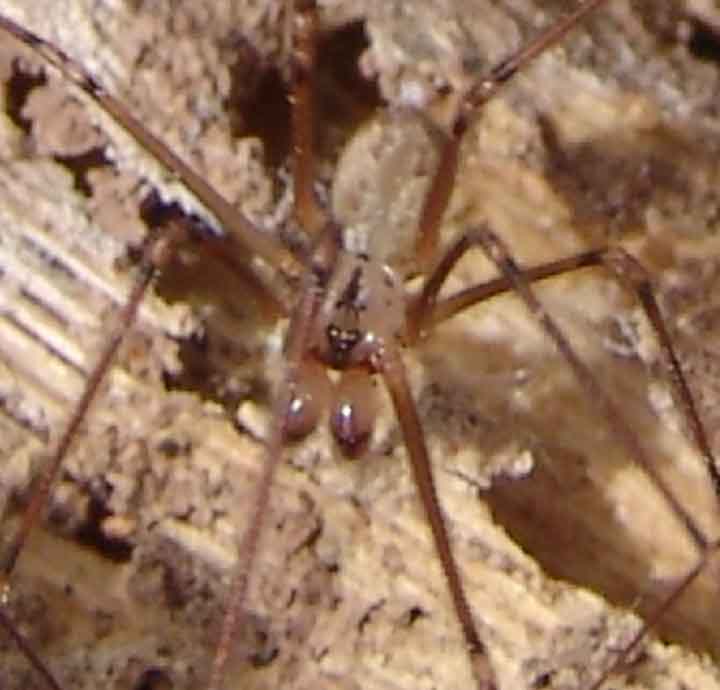
In the close-up we can see one set of three eyes, and darkening at the "knees" of the insect. Note also the plumpness of the pedipalps, which is typical for the males.
Here, below, found on an overturned rock from the same area in March 2005, is another species, this one much smaller than the ones just above, with a white stripe running down its dorsal abdomen:

Nursery-web Spiders (Family Pisauridae)

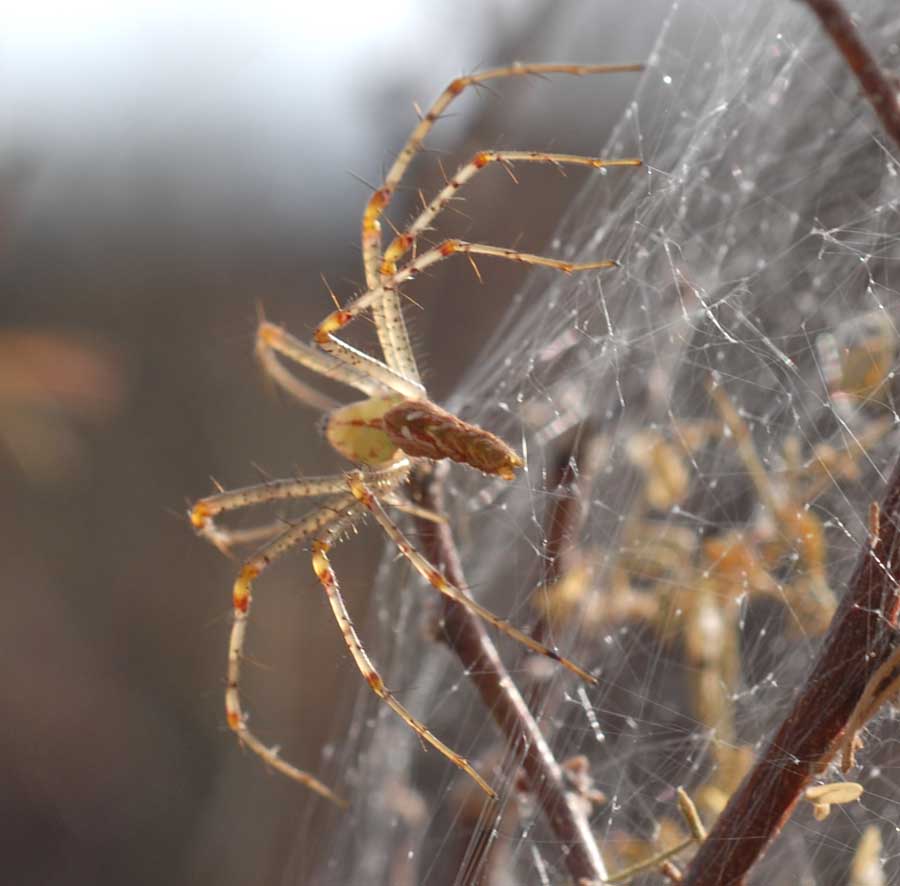
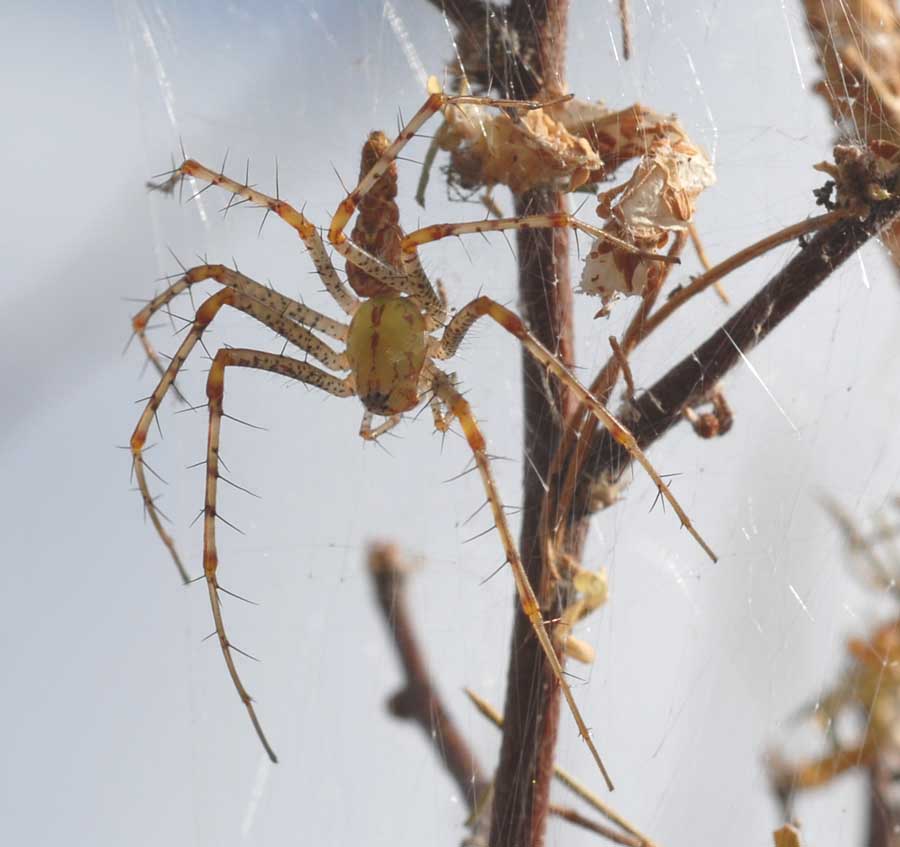
At twilight in November 2007, our entomology naturalist Margaret McClelland sighted this family above, actively occupying a branch of a mesquite tree in lower Hot Springs Canyon. The mother is of course clearly visible, the baby spiders much tinier and were a revelation to see as they scampered about in the web. Below, we returned two days later in mid-afternoon, obtaining a much better view of the mother: at left, a dorsal view from the rear; in the middle, a top dorsal view; at right, a ventral image. (Click on each image to enlarge it.)
 ..
.. ..
..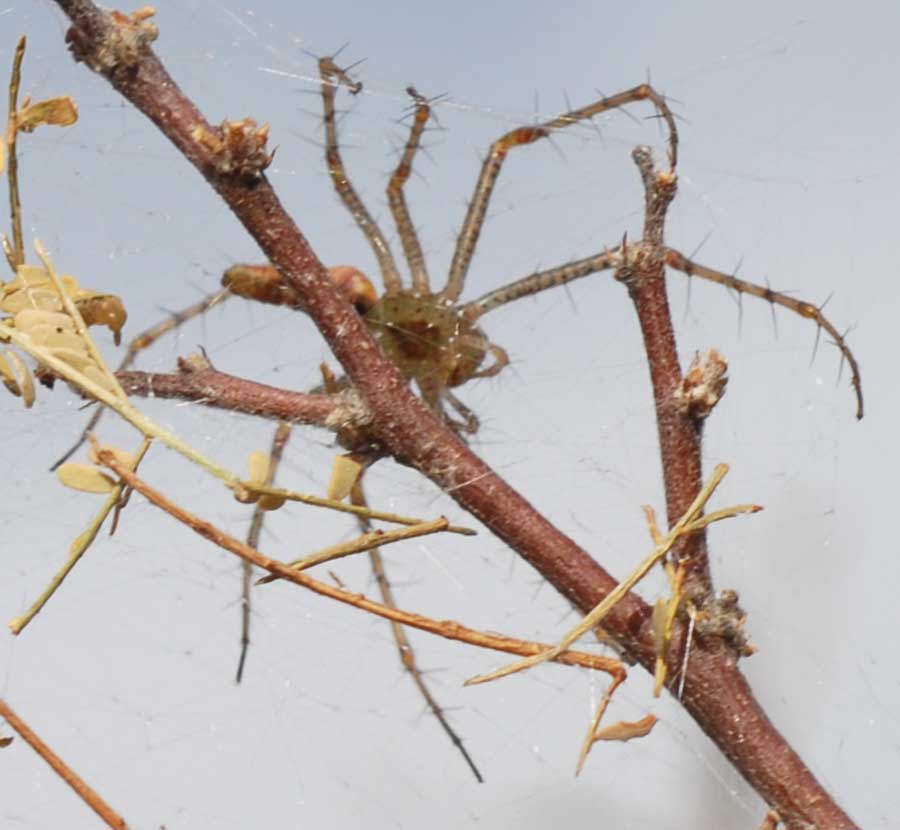
These are substantial, quite long-legged spiders, often displaying the black spines along the legs you see above. Longitudinal stripes along the oval-shaped carapace are typical.
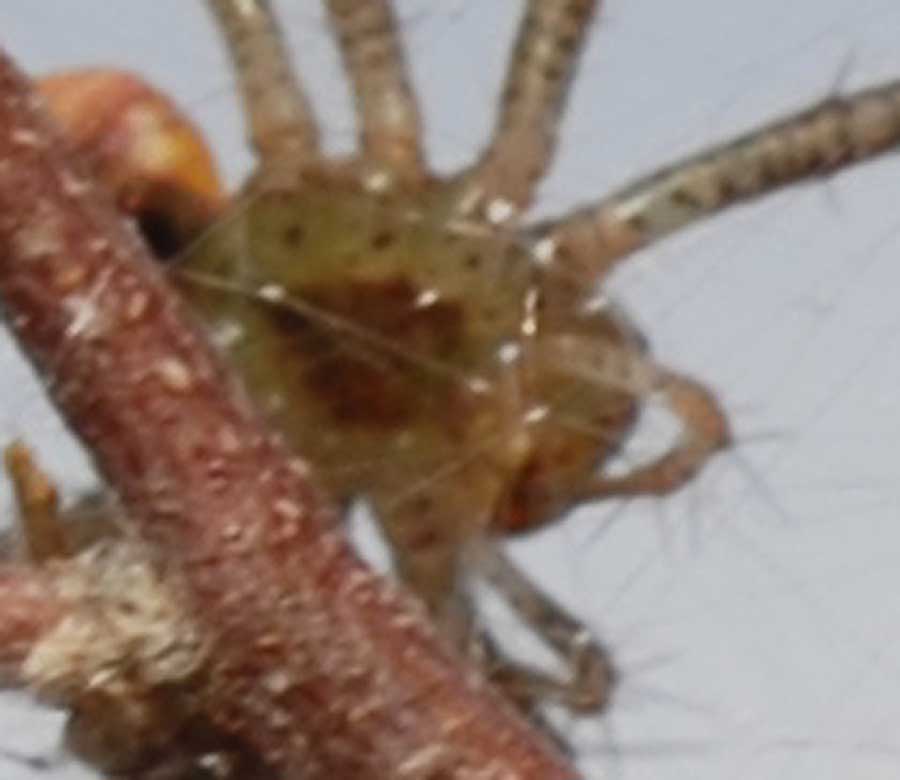
Below, three closeup views of image details -- at left, the dorsal abdomen; at middle, the cephalothorax, especially the eye area, and the pedipalps; at right, our best ventral view. (Click on each image to enlarge it.)
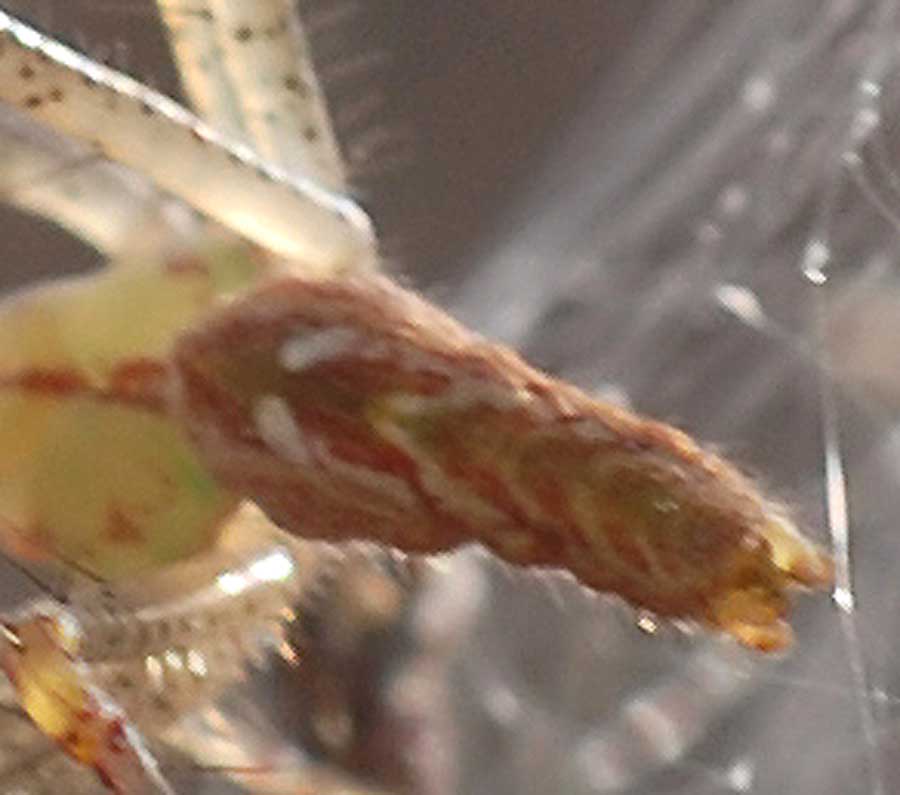 ..
..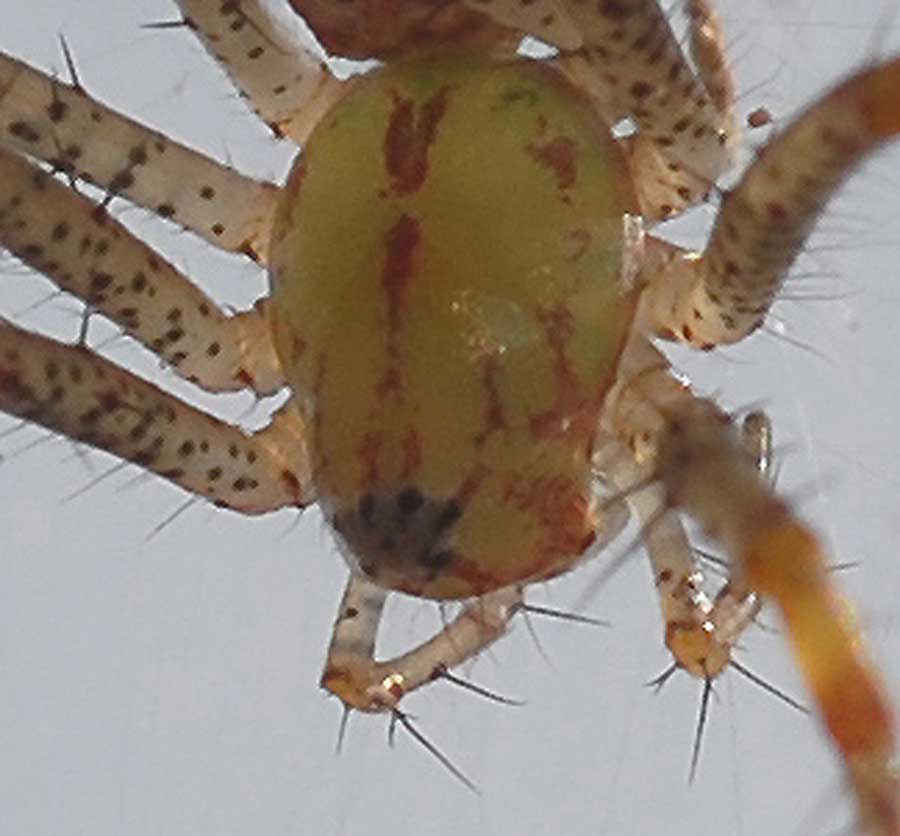 ..
..
We did not capture very clear images of the babies, but these two below show the normal shape of the abdomen of a young Nursery-web Spider.
 ..
..
The definitive feature of Nursery-web spiders consists in their construction of a nursery web tent which serves to protect the egg sac and then the young spiders until they have undergone two moults. The Pisauridae are closely related to the "Wolf Spiders" (Lycosidae), but unlike the latter (who carry their egg sacs at the back of their abdomen), Nursery-web Spiders carry their egg sacs in their pedipalps and chelicerae. Their distribution is worldwide, comprising a family containing some 10 genera and 25 known species. These include not only the ground-and-tree-dwelling forms as shown above, but also a group of what are called "fishing spiders", who can move across water and catch small acquatic animals (including fish).
According to McGavin, while the terrestrial spiders of this family tend to build their nursery web in vegetation, they do their hunting along the ground. We wondered about this in this instance, since surrounding the vicinity of this web among the mesquite, paloverde, and acacia branches in the vicinity are large numbers of burn-worm corpses:
 ..
..
These are corpses, not molted caterpillar skins, and we wondered how they had died. Far too few spider webs are visible in the vicinity of this carnage to account for the bodies distributed along the high branches of these trees and shrubs. (Our soil scientist Tom Orum suggests an epidemic caused by some kind of virus, since the Hawk Moth adults observed at the end of the season were few this year and the burn worm corpses many and widespread.)