 ..
..
1. The Age of the Earth (and its evidence in our area)
[In the following discussion, you may want to refer to an authoritative geological time scale; to see one adapted from the work of the University of California Berkeley Museum of Paleontology (cited in Credits & Bibliography) click here.]
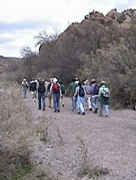
Mick Meader began the session with an overview of the time dimensions involved in Hot Springs Canyon (HSC) geology, and more broadly the geology of the American Southwest, illustrating time by means of a roll of toilet paper:
 ...
... ...
...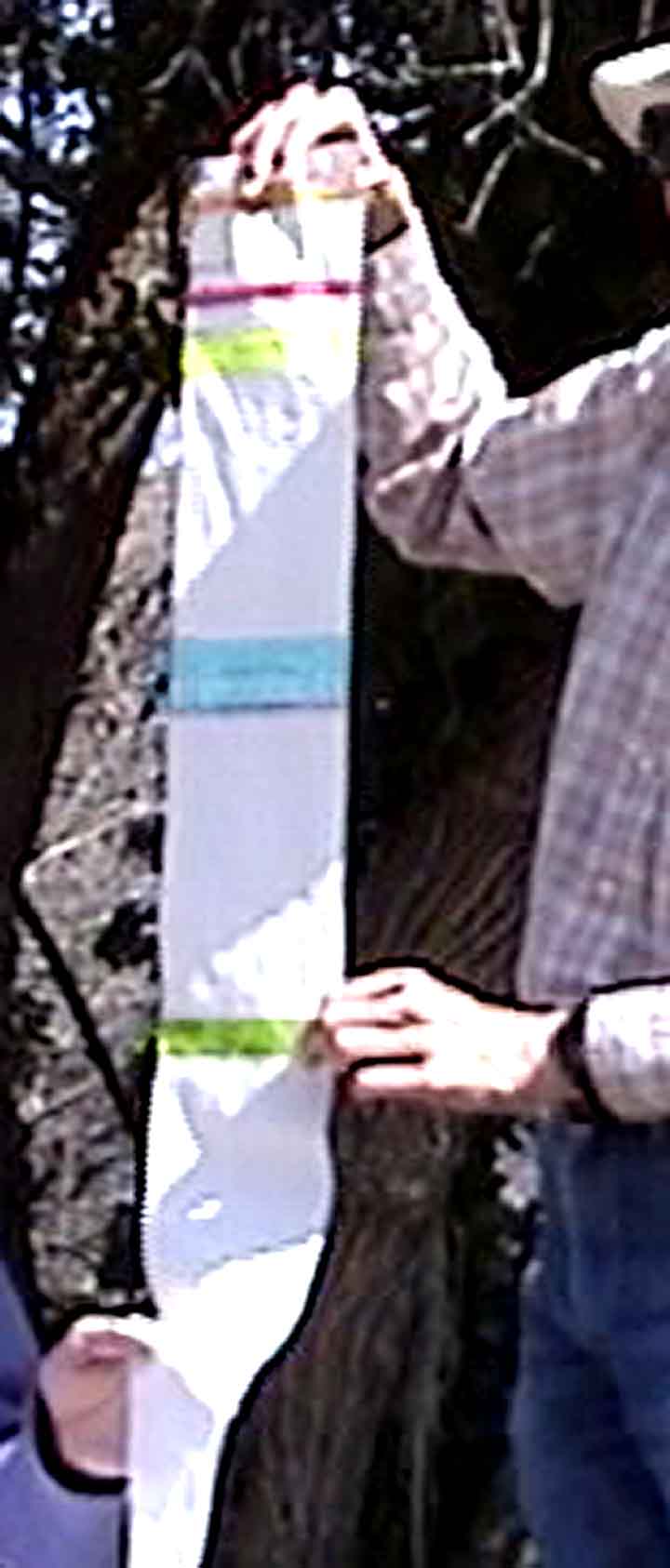
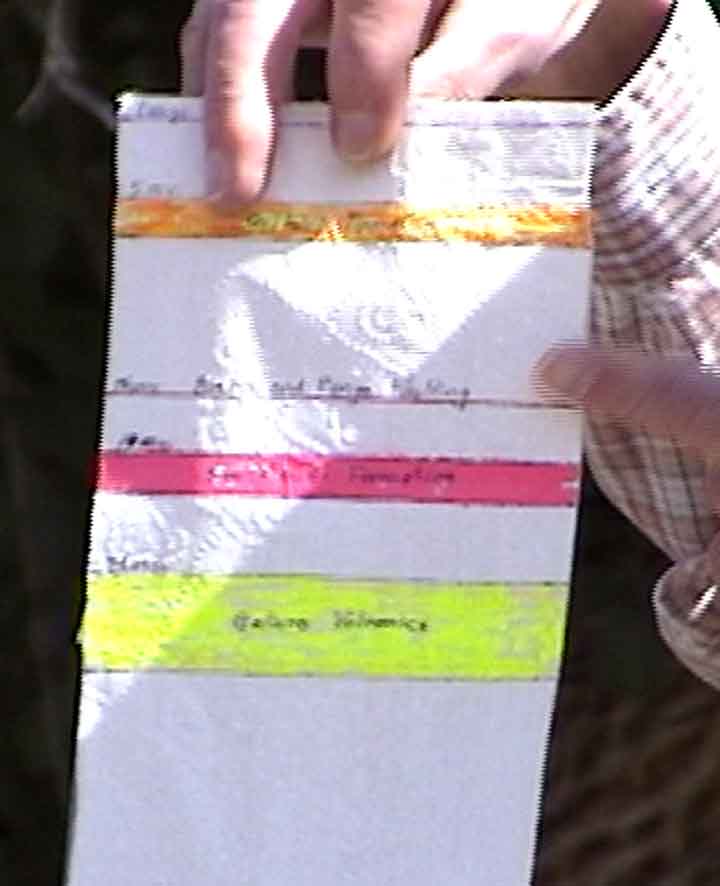
In the picture above left, Mick began by equating each sheet in the roll with 20 million years, thus a full roll of toilet paper -- if it had 225 sheets rather than 200, as this roll has -- about equals the total age of the earth (about 4.5 Billion years). In the middle picture, Mick observed that the time of the first modern Homo Sapiens (say 100,000 years) cannot even be shown on the edge of the first sheet of paper, while the past-time appearance of the first human beings, about 1 Million years ago (1 MYa), is represented by the narrow dark line beneath the nail of Mick's index finger (upper-right at the top of the sheet. Click on the image to enlarge it). The Quiburis Formation of our area, which runs from about 7.5 to 5 million years ago (MYa), is represented by the orange strip at the tip of his leftmost finger in the image. This is roughly the time when the ancestors of human beings separated from the Great Apes (most closely, the Chimpanzee / Bonobo group). Further down the sheet, the narrow dark line running just below the finger on the right side of the paper represents the time of the Basin-Range Block-faulting that produced the HSC topography of today, which began around 15 MYa. Below that, the broad red strip represents the San Manuel Formation, deposited about 20-18 MYa (about the end of the first toilet-paper sheet), while the even broader yellow band represents the Galiuro Volcanics, which is just a short ways into the second sheet of toilet paper, about 25-24 MYa. In the right-hand picture (Click on the image to enlarge it), Mick shows the two other main formations to be seen in Hot Springs Canyon, the Cascabel Formation (shown in blue, at 70-65 MYa), and the Willow Canyon Formation (shown in green), which is about 6 sheets of paper down from the top, at 120 MYa (Lower Cretaceous in age).
Below, this time-scale is summarized formally (though not accurately in terms of time duration reflected in vertical length as was shown above) in relation to the
Major Geological Deformations in Our Area

The oldest rocks that are found in HSC, by far, are "clasts" (pebbles, cobbles, boulders) embedded in the San Manuel Formation sediments, the result of erosion from the uplifted granodiorite formations to be found in the Johnny Lyon Hills, which are 1.65 Billion years old -- only about a third of the way back through the toilet paper roll. Below: a view of these Johnny Lyon Hills (located east of the Cascabel Road at The Narrows):

For a time-frame summary, see Meader: Geological History of our Area.
Next
Previous