
2. The Basin-Range Faulting Process
Mick and Bob then discussed the Basin-Range faulting process of 15 MYa, the process which produced the major landscapes we see in our area today.
[In the following discussion, you may want to refer to an authoritative geological time scale; to see one adapted from the work of the University of California Berkeley Museum of Paleontology (cited in Credits & Bibliography) click here.]
Mick illustrated how the contrast of Basin-and-Range developed through a process of extension of the continental crust, causing faults which made major blocks of formations drop thousands of feet ("grabens"), while other blocks remained higher or even rose ("horsts"). The model he shows below illustrates this, the one at left showing the land when compressed, the one at right when the land is pulled apart, breaking along various fault lines, some parts dropping and others rising.
Bob applied this to the map (below right) of the lower part of the Basin-Range Province, his hands stretching apart to reflect an East-West direction of spreading for the entire West and Southwest east of the Sierra Nevada. He observed that this stretching, block-faulting process is still occurring in the further northern part of the Basin-Range Province, in British Columbia. In our area, it began at 15 MYa, stretches into northern Mexico, but has now almost ceased. (Click on the right-hand image for an enlargement.)
 ..
.. ..
..
This stretching and fault-block breakage produced the large array of roughly north-south running mountain ranges, separated by parallel valleys that you can see depicted on the map at right above.
Viewed from more or less southeast-to-northwest, one can see that the continental crust of the Basin-Range Province has about half the thickness of the continental crust elsewhere in North America: (Click on the image to enlarge it):
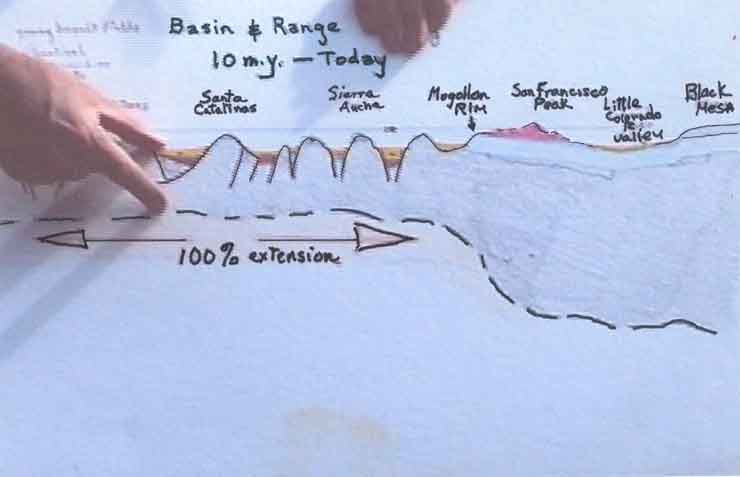
This diagram projects a roughly southeast-to-northwest cross-section of the continental crust in our area, running from the Pinacate Mountains in Mexico to the Whetstone Mountains (both are at far left, under Bob's right hand), across the Santa Catalinas, Sierra Ancha, and the Mogollon Rim to the further uplands of the Colorado Plateau at right. The double arrow shows a "100% extension" (with its associated faulting process) that took place over a period of 2-3 MY, accommodated by numerous faults, one earthquake at a time, which occurred in an east-west axis as well as the one shown southeast-northwest. The entire area remains more seismically active than in the areas of thicker continental crust, because of the hotter, shallower mantle lying beneath this part of the region.
Part of this heating (and the "taffy-pull spreading" associated with it) may have been due to subduction of the East Pacific Rise -- the oceanic spreading center to the west of North America in Cretaceous times -- it being pulled under (pulled beneath) the western edge of North America beginning about 30 Ma. In the map image below, see the purple spreading center running from the bottom upward, leading into the Gulf of California (Click on the image to enlarge it):

Dickinson and others have modeled this crustal thinning as due to the changing angle of subduction of the Pacific Plate under the North American Plate. At any rate, the thinning and stretching of the crust, which first caused the volcanism of the Mid-Tertiary Orogeny, later produced the extensional faulting that created the Basin-Range structures.
Basin-Range faulting in Hot Springs Canyon is nicely shown at the Yellow Cliffs, where our outcropping of Galiuro Volcanics now sits side by side with the younger San Manuel Formation. The San Manuel formerly was deposited above this part of the Galiuro Volcanics, but dropped down with the fault somewhat more than 10 MYa:

Above, on the left, gray San Manuel Formation; on the right, Yellow Cliffs Galiuro Volcanics. Both formations, originally deposited in more horizontal layerings, were sharply tilted by Basin-Range faulting, which began about 15 MYa. The Teran Wash Fault, part of the more widespread faulting process of those times, runs as Mick Meader indicates toward the left-upper-middle of the picture, to the right of the whitish pyramid which stands in the far distance (below the line of Soza Mesa; we're looking more or less northwest in this image.) The whitish pyramid is part of San Manuel Formation which has fallen away from the main SM Formation to the left; the purplish hill to its right is Galiuro Volcanics. (This photo was taken on the earlier Geology Walk in November 2000.)
Below, a close-up view of a piece of sharply-tilted San Manuel Formation along the Teran Wash Fault pointed to by Mick Meader in the photo above. This big chunk appears to have fallen down from the main body of San Manuel Formation in a distinctive alignment of its own.

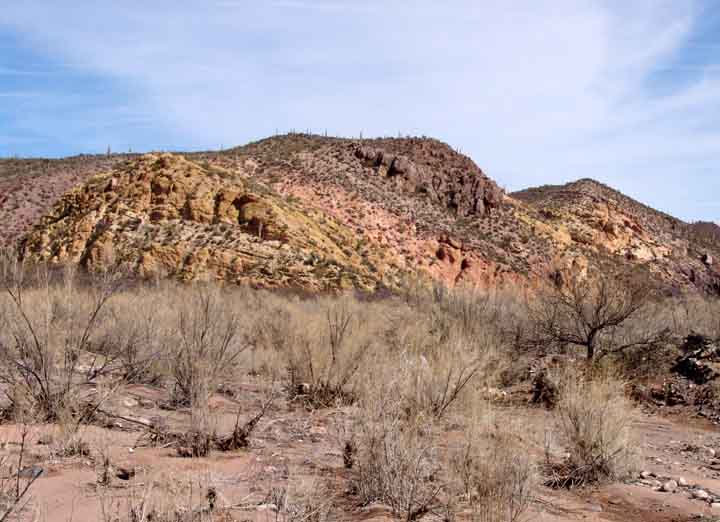
Below, a better view of the Yellow Cliffs Galiuro Volcanics themselves from a ways further downstream. We see here several layers, the lower yellowish, higher pink, higher still dark purple. In this photo, the sharp, fault-block tilt of the Formation, dipping downward away from the viewer, is more clearly evident: (Click on the image to enlarge it)
Below, a portion of the geological map of our area (compiled by Goodlin 1985 and Mark 1985 -- see Credits & Bibliography), showing how the Teran Wash Fault runs through the Hot Springs Canyon from NNW to SE. (Click on the image to enlarge it):

In the image above, the yellow "Qal" means Quaternary Alluvium -- the contemporary floodplain; the beige "Tq" means "Tertiary Quiburis Formation"; the darker brown "Tsm" means Tertiary San Manuel Formation; and the pink formation is Galiuro Volcanics. The dark line running diagonally from upper-left-center, then reappears across the canyon to lower right marks where the Fault can be observed on the ground, the dotted line where it is presumed to run, but is buried under the more recent formations.
An aeial view of the same formations is useful here, with the red lines roughly marking the position of the Fault::

Mick Meader has provided us with the following model of this fault: (Click on the image to enlarge it):

Taking a more macroscopic perspective, note the tilt of the Galiuro Mountains as a whole when viewed from the West. This aerial photograph, below, shows the Fore-range in the foreground, while the higher, Back-range appears in a more blue, aerial cast, with its down-and-away tilt quite pronounced (Click on the image to see this detail more clearly):

The whole extent of the Galiuros Mountains forms a Fault-block Range of this kind. See This link for a panoramic view of the Galiuros from South to north, as seen from the top of the plutonic granite core-complex of Mount Graham further east.
For a summary placing the Basin-Range process in its wider historical context, see Meader: Geological History of our Area.
Next
Previous