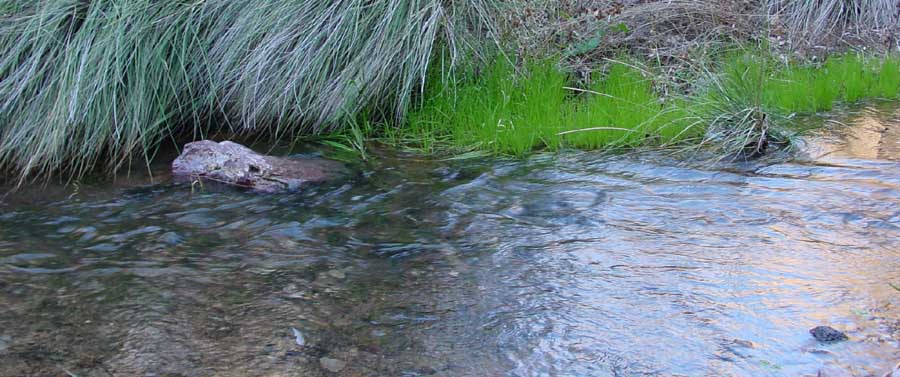
Saguaro-Juniper Fish (Hot Springs Canyon)
Sources: Native Fish of Arizona: a Vanishing Legacy (poster produced by Az Game & Fish in cooperation with the US Forest Service, provided courtesy of Pat Malchow), and "Monitoring Results for Hot Springs Creek, Muleshoe Ranch CMA: 1992-1999", courtesy of Daniel Baker and TNC.
For detailed information on the situations of our native fish in the Gila River Basin of Arizona and New Mexico, see this U.S. Bureau of Reclamation link: Native Aquatic Species (Gila River Basin AZ & NM).
The Nature Conservancy has been monitoring fish populations in our area, with the following results for 1999:
The two most abundant fish were Dace, more specifically the Longfin Dace (Agosia chrysogaster), about 56% of all fish captured, and the Speckled Dace (Rhinichthys osculus), about 25%.
Click on the fishes to enlarge them.

The Longfin reaches about 4" (10 cm) in size, and is one of our most adaptable native fishes, withstanding extreme heat and poor oxygenation of water. It feeds on both detritus and aquatic invertebrates, and is common in Arizona rivers. The Speckled reaches the same size, displays a wide variety of form and color variations. The only native fish that occurs naturally in all 7 Western North America drainages, it eats algae, detritus, and aquatic invertebrates.
The third most common fish in Hot Springs stream in 1999 was the Desert Sucker (Pantosteus clarki), comprising about 14% of all fish captured:
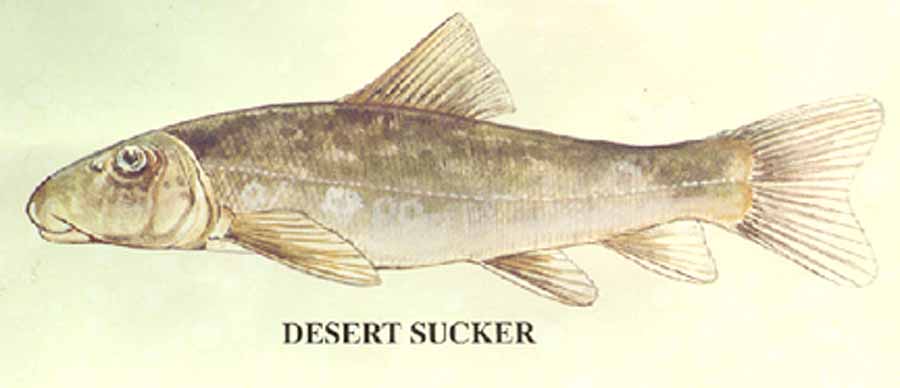
This fish reaches 11" (28 cm), prefers to live in flowing pools, and is common in Arizona. Its juveniles prefer insect larvae, while adults eat algae and other plant material scraped from rocks. Remains of these fish in archeological sites indicates their formerly extensive use as food by the Northern Pima.
Fourth is the Gila chub (Gila intermedia), 3.9% of all fish captured, but formerly quite rare in Hot Springs, and this proportion indicates considerable increase:
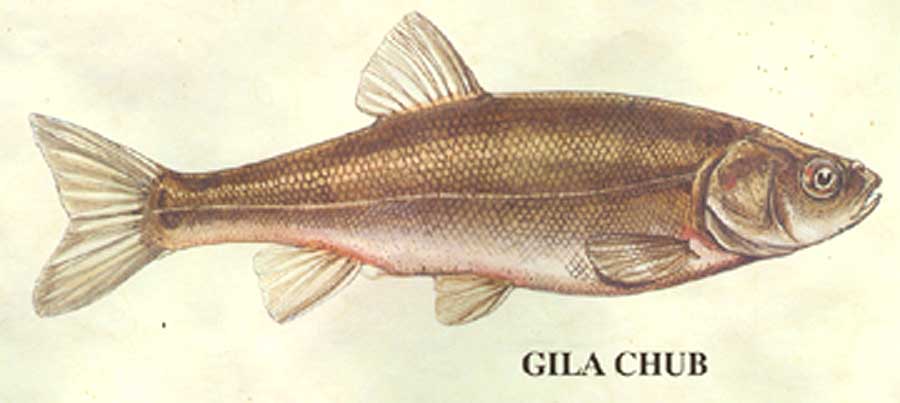
These reach 10" (25 cm) in length, and prefer deep, slow-moving pools. Formerly associated with now-vanished cienegas around the state, they feed on invertebrates, smaller fishes, and organic matter. It is a threatened species in Arizona.
Fifth is the Sonora sucker (Catostomus insignis), which is fairly abundant in the Gila drainage:
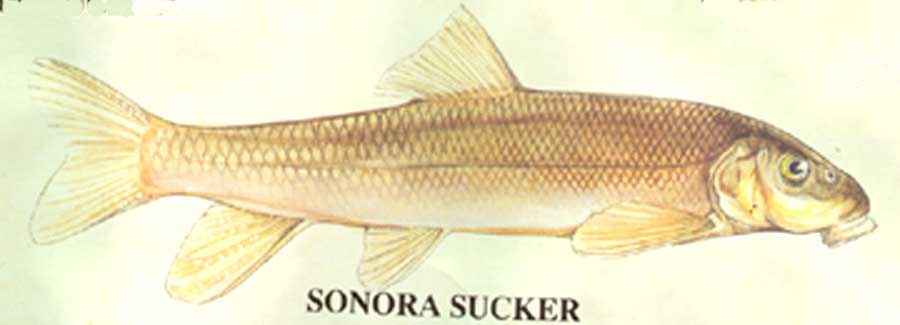
This too has been rare in Hot Springs, accounting for 1.2% in 1999. It can become quite large (up to 30", 76 cm, 4 lbs). It feeds on gravelly bottoms.
..............................................
Two fish not now found in Hot Springs, but formerly more widespread in the Gila drainage and now considered threatened species in Arizona, are shown below:
The Spikedace (Meda fulgida)
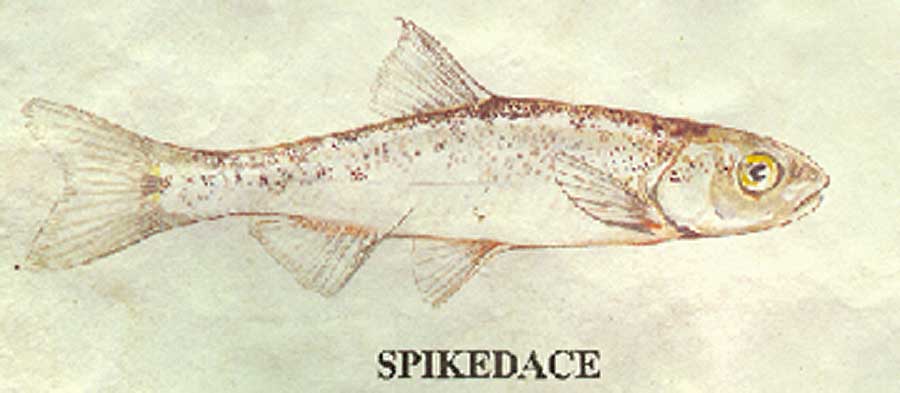
This fish reaches about 3" (7.6 cm) in length and is native to the Gila River basin. Males become brassy colored during breeding season, females retain the silver coloration year-round. They feed on aquatic and terrestrial invertebrates.
Gila Topminnow Peociliopsis o. occidentalis)
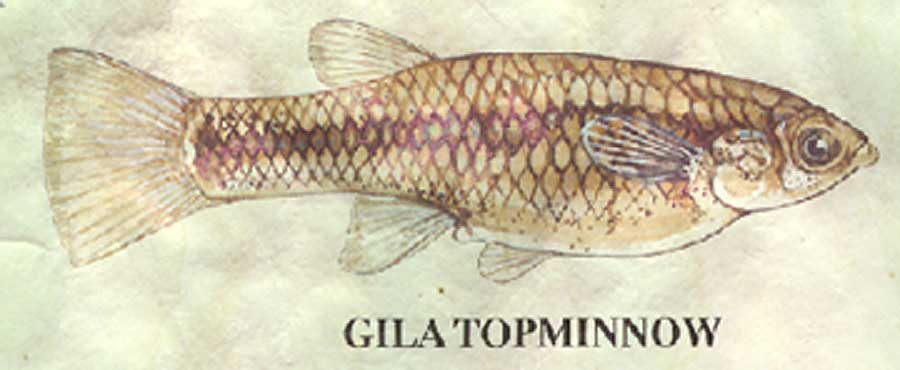
This fish reaches about 1 3/4" (4.4 cm), was once common in the Gila River drainage, but is now restricted to a few natural sites in the state. It gives birth to live young, feeds on organic detritus and small invertebrates.
For more information on these two threatened species, see Environmental Assessment 1999.

Back to Our Lands and Their Creatures