Jaguar (Felis onca)
(See also O'Brien, Stephen, & Warren Johnson, "Evolution of Cats", Scientific American July 2007, pp. 68-75)
Like Mountain Lions, Jaguars are large, tawny-colored cats, but the adult Jaguar's background color is uniformly covered with spots -- on tawny back and sides with rosettes(a ring of black with a small black spot in the center) and on the white belly with black spots (Burt & Grossheider, cited on main Mammals page, p. 77).
According to recent DNA studies (see citation above), Jaguars are members of the Felid lineage Panthera, which includes all the great "roaring cats"(lion, tiger, leopard, jaguar, and snow leopard) and was the form ancestral to all modern cats. These new DNA studies suggest that jaguars entered the New World from Asia together with lions some 3 to 4 million years ago, then both were exterminated from North America during the Pleistocene extinctions, but the Jaguar had continued into South America and then in Holocene times returned to the north from that late-Pleistocene sanctuary.
Once ranging as far north as the Great Plains, this big cat now barely enters the United States -- according to Burt & Grossheider [p.79], only in the southeastern tip of Arizona and the southwestern tip of New Mexico. Recent more northerly sightings in southeastern Arizona suggest that a few more may be straying toward our area, so we make reference to them here.
Since 2003, conservationists from the southwestern United States and Mexico have joined to form Northern Jaguar Project, a group building a sanctuary preserve in the Sonoran Sierra Madre between the Aros and Yaqui Rivers in order to protect these endangered wild cats. The NJP also operates a small scientific research station there to study the biodiversity of this critical area. See that link for more information on this important binational conservation effort.
Below is a copy of a recent article on the subject by Kent Patterson of the Center for Latin American and Border Studies at New Mexico State University, Las Cruces.
The Return of a Big Border Cat?
Fierce and secretive, the jaguar long has long held mystical and spiritual significance for the indigenous cultures of the Americas. Today the big cat continues to stir symbolic meanings for many others as well. Sports teams, a sleek automobile and a leading Mexican rock group are all named after the wild animal. Once inhabiting a vast area from Patagonia to the Great Plains of North America, the jaguar's survival is threatened by hunting and habitat destruction. Now, some hope to turn the situation around and ensure the protection and recovery of jaguars across national borders.
An international symposium dedicated to jaguar preservation concluded this past weekend in the south-central Mexican city of Cuernavaca, Morelos. Attended by about 50 wildlife specialists, veterinarians and environmental officials, the meeting resolved to redouble jaguar recovery efforts and develop a health protocol for diseases that afflict the animals. Quoted in the Mexican daily La Jornada Morelos, Dr. Rodrigo Medellin said Mexican scientists have decades under their belt of developing "very concrete studies related to the survival of the jaguar" in different regions of their country.
Bill Van Pelt, the non-game birds and mammals program manager for the Arizona Fish and Game Department who attended the Cuernavaca seminar, said in an interview with Frontera NorteSur that jaguars are a priority species for the Trilateral Committee, a tri-national wildlife monitoring body made up of Canada, Mexico and the United States.
In Mexico, jaguar populations are mainly concentrated in the nation's southern and northern borderlands. Significant concentrations are found in the Yucatan Peninsula and the Lacandon Rainforest of Chiapas state, as well as in northern Sonora state south of Douglas, Arizona, where an estimated 70-100 animals are believed living. Jaguars were once believed extinct in the United States, but several wild cats have been photographed in the border regions of southern Arizona and southern New Mexico since 1996, most recently in July of this year when a new picture of a jaguar was snapped in Arizona.
The reappearance of jaguars in the Mexico-US borderlands is encouraging a small but steady movement to preserve the mammals and assure their recovery.
"The public is very interested and engaged in conserving this species," Van Pelt said. "People believe that this is a jungle animal," he added, "but that doesn't mean they can't occur in other habitats." Van Pelt said clusters of jaguar like the ones found in Sonora could represent keys to the species' future survival, constituting population pockets able to withstand ailments or other threats threatening denser, core groups.
"If the animals aren't conserved in Mexico, they won't be here," he said. "Mexico is being very aggressive at jaguar conservation. They see a very direct connection culturally with the animal." An advisory committee to Mexico's Ministry of the Environment and Natural Resources is developing recommendations for the jaguar's future. The Mexican federal environmental agency is in the process ofdeveloping a nationwide jaguar protection plan for 2006, according to Van Pelt.
Like the Mexican gray wolf, the jaguar has been a bone of contention between environmentalists, wildlife officials and ranchers in this country. Unlike the Mexican gray wolf, which was reintroduced over the protests of some ranchers who feared livestock depredations, a US jaguar protection policy would involve protecting an animal which may have been north of the border all along.
"I was thrilled to learn about the photos of a jaguar taken in (New Mexico's) Peloncillo Mountains in 1996," said Michael Robinson, a New Mexico representative of the non-profit
Center for Biological Diversity (CBD) "The presumption is that these are jaguars from Mexico which are reclaiming their old territory, but no one knows that for a fact."
Robinson said it's possible jaguars could be roaming as far north as New Mexico's Gila Wilderness. The jaguar advocate told Frontera NorteSur that a personal acquaintance from Silver City spotted what could have been a rare black jaguar in the Gila area in 1999.
Plaster casts made of the animal's tracks indicated it was either a jaguar or an extremely large mountain lion, Robinson added. Jaguars are bigger than their smaller cousin, the mountain lion.
Van Pelt contended that jaguars spotted in recent years in Arizona are likely to be animals which have crossed over from Mexico, based on available surveillance evidence and hunter reports. He said two or three big cats have been pretty well documented as presently living in Arizona. Despite their tiny numbers, jaguars
were kept off the US endangered species list until 1997. Six years later, the CBD and Defenders of Wildlife sued Interior Secretary Gale Norton and the United States Fish and Wildlife Service to force a jaguar recovery plan under the Endangered Species Act. The suit was settled last year, giving the USFWS until July 2006 to decide whether or not to designate critical habitat for the jaguar.
In Arizona and New Mexico, meanwhile, the Jaguar Conservation Team has been assembled with representation from government officials, ranchers, landowners, and environmentalists. According to Arizona Fish and Game's Van Pelt, who serves as the habitat subcommittee chair for the team, quarterly public meetings are being held, with the next one possibly happening in the next few weeks. Van Pelt's subcommittee is using GIS technology and other methods to characterize jaguar habitat on this side of the border.
National security is one matter that could complicate the jaguar's future north of the border. The CBD's Robinson said border control measures under consideration by the US Department of Homeland Security including fences, new roads and stadium-style lights could restrict the movements of wild cats and "affect the ability of the U.S. to recover the jaguar."
Kent Paterson
Frontera NorteSur (FNS): on-line, U.S.-Mexico border news
Center for Latin American and Border Studies
New Mexico State University
Las Cruces, New Mexico
For a free electronic subscription email fnsnews@nmsu.edu
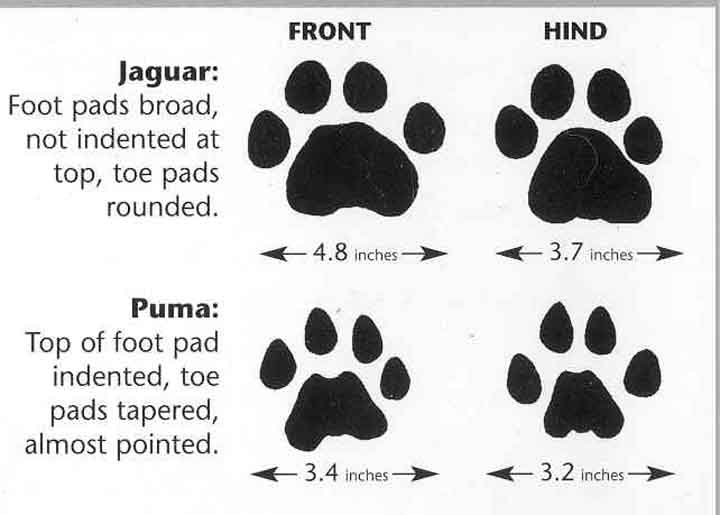
A comparison of Jaguar and Mountain Lion tracks is provided below (click on the image to enlarge it):
Return to Mammals