
Sacaton (Sporobolus wrightii) and Alkali Sacaton (S. airoides)
Main Sources: Gould, Frank, 1951, Grasses of the Southwestern United States, Tucson: University of Arizona Press; Shreve, Forrest & Ira Wiggins, 1964, Vegetation and Flora of the Sonoran Desert, Vol. 1, Palo Alto: Stanford University Press; Kearney, Thomas & Robert Peebles, et al., 1960, Arizona Flora, Berkeley: University of California Press; McClaran, Mitchel & Thomas Van Devender, 1995, The Desert Grassland, Tucson: University of Arizona Press; van Devender, Thomas & Mark Dimmitt, "Desert Grasses", in Phillips, Steven & Patricia Comus, eds., 2000, A Natural History of the Sonoran Desert, pp. 265-80, Arizona-Sonora Desert Museum Press, Tucson; Ruyle, George & Deborah Young, eds., 1997, Arizona Range Grasses, Tucson, University of Arizona College of Agriculture; USDA Conservation Districts of Southeastern Arizona, n.d., Grasses of Southeastern Arizona. Washington, D.C.
Sacatons are sturdy warm season, perennial bunchgrasses with firm, tough stems. These grasses form dense clumps from a hard, knotty base. Sheaths and blades of the leaves are firm and fibrous. As you can see in the banner image above, these grasses grow well over 3 feet in height, and, requiring considerable water, appear mainly in our floodplains. David Omick here stands in the floodplain of the Middle San Pedro River near Cascabel on February 6, 2009.
In earlier times, Sacaton was common in our area. Prior to the 1760s (when they were preemptorily relocated to the vicinity of Tucson by the Spanish), the Native American O'odham residents of the valley regularly set large stands of it afire, which stimulated its spread, but 19th-century Euro-American immigrant landholders with their cattle both facilitated the spread of mesquite bosque and suppressed fire, leading to a decline of these grasses. Valuable soil stabilizers, they are now being reintroduced in some places along the river. See this dense stand along another stretch of the Middle San Pedro River floodplain, photographed on February 6, 2009:

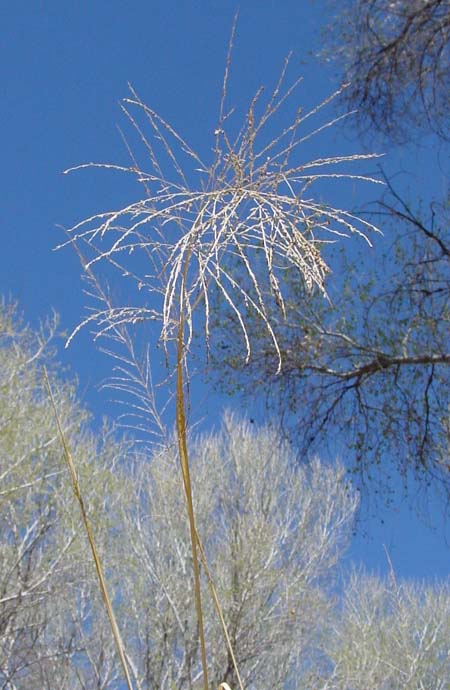
Stems are firm and tough, while Inflorescences are 6 to 18" long, with open panicles displaying wide-spreading branches, branchlets and spikelets, shown below, photographed on the Three-links Ranch in February 2003. Click on the image to enlarge it.
In Lower Hot Springs Canyon, where Sacaton grasses have been absent in our Saguaro Juniper experience (since the 1980s anyway), Daniel Baker has tried re-establishing some stands. Here below is a small stand planted near the Windmill where it could receive occasional local irrigation, photographed in December 2001:

Back to Grasses